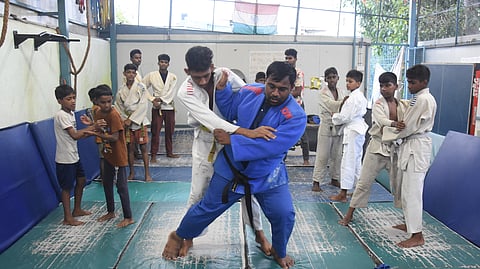

CHENNAI: The early morning mist still hangs heavy over the Thiruvanmiyur neighbourhood of Chennai when the first thud echoes across the concrete. It is 5 am. While the rest of the city sleeps, a small group of children is already sweating, tossing their bodies onto thin mats, and learning the disciplined art of falling. Among them are 11-year-old R Raja and 12-year-old M Sabari.
Raised by single parents within a Greater Chennai Corporation-run homeless shelter operated alongside the Jeeva Jyothi Children’s Home NGO, Raja and Sabari have spent their childhoods navigating a world that offered very little footing.
Their story feels like a real-life version of Dangal, where a relentless coach moulds young talent from humble backgrounds into champions. Against overwhelming odds, the duo recently secured a life-altering victory. Out of nearly 115 athletes who participated in the statewide Sports Development Authority of Tamil Nadu (SDAT) judo selection trials, only 12 were chosen. Raja and Sabari emerged as the sole successful candidates from Chennai, earning places at the prestigious SDAT Boys Hostel at Nehru Stadium under the special category of judo.
The catalyst for this transformation arrived on February 17, 2021, in the form of 31-year-old D Sarathy. On paper, Sarathy was hired as the shelter’s night watchman, but in reality, he was a mentor on a mission. Having practised judo since Class 11, he believed sports could transform vulnerable lives by instilling confidence, discipline, and ambition. His commitment to social service dates back to his college days with the National Service Scheme and Rotary Club, and he had taught judo to juveniles through the PRISM NGO as part of rehabilitation efforts.

“It all began with a thought that I can’t give money to them, but skill can be shared,” says Sarathy.
To understand the magnitude of their triumph, one must look at the paths that brought both boys to the shelter. Raja, now a Class 8 student, and his family came from Ammapettai in Kallakurichi, where he was born to daily wage labourers, B Ramesh, and his wife. The family frequently moved between construction sites across districts, often living in temporary shelters.
Their lives changed during the Chennai floods of 2015. While working at a city construction site, Raja’s mother died from health complications shortly after the floods. Unable to cope with the loss and struggling to raise his children alone, Raja’s father eventually admitted his two sons to the corporation shelter. Raja initially struggled to adjust but gradually found emotional support, friendships, and opportunities to learn. The shelter encouraged children to participate in cultural activities, sports, and extracurricular programmes.
Sabari’s life story follows an equally difficult path. His father abandoned the family when he was three or four years old. His mother, Nandhini, who belongs to the Narikuravar community, made a living selling handmade chains and small accessories. With three children to support and no stable housing, she decided to enroll Sabari and his younger brother in the Thiruvanmiyur shelter, while she and her daughter now live in a makeshift house in Kalpakkam.
At the shelter, Sabari found a safe environment and developed a passion for sports under Sarathy’s guidance. Financial hardships during the Covid-19 pandemic had temporarily forced Sarathy to step away from voluntary social work and take up paid employment as a school physical education teacher. During that period, he became associated with the Jeeva Jyothi NGO and learned about the corporation shelter.
Every morning from 5 am to 7 am, Sarathy conducts intensive judo training sessions. His dedicated trainees, Raja and Sabari, recently joined new schools while residing and training at the SDAT hostel. Although the sports program grants these students school fee concessions, Sarathy personally covers their remaining educational and personal expenses, which amount to nearly `3,000 per student. He credits his wife, V Divya — a physical director at a government school in Porur — as his constant source of strength and support
Sabari has represented Tamil Nadu at the national level twice, while Raja has competed in one national championship and won a gold medal in the boys under-19 25-kilogram judo tournament at the 68th National School Games in 2024.
“With our master’s support, we have reached this stage,” said Sabari. “My goal now is to win medals for Tamil Nadu and India at the national and international levels.”
Raja said, “Life here is different. We get nutritious food, better facilities, and more time to train. I want to achieve great heights in judo and win medals at the international level. There are many talented children at our shelter who deserve opportunities like this, and I hope they too find their way here one day.” Sarathy believes their success story should serve as a model for helping other vulnerable children in homeless shelters.
As Raja and Sabari settle into their new lives at the SDAT hostel, their stories stand as reminders of how timely support, dedicated mentorship, and access to opportunities can transform the future of children growing up on the margins of society.
(Edited by Subhalakshmi PR)