
NAGAPATTINAM: Every evening, before the clock strikes five, the quiet routine of R Alamelu’s household gives way to a different rhythm. As she stands at the kitchen sink, finishing the day’s dishes, her fingers move rhythmically, as though pressing invisible keys, rehearsing the tunes she has been learning at the Performing Arts Academy. “My son left a keyboard at home when he moved to Chennai for higher studies. Now I am playing it before sleeping every night after learning in class,” Alamelu says.
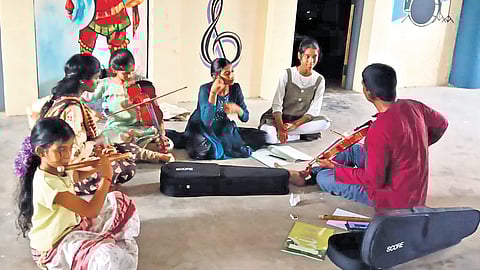
Like Alamelu, who is a homemaker, this has been the routine for more than 100 students at the Performing Arts Academy in Nagapattinam, a space created to make music accessible to people from diverse, often underprivileged backgrounds only for Rs 250. The Performing Arts Academy, inaugurated by the School Education Minister Anbil Mahesh Poyyamozhi on January 29, was initially opened for students of all age groups. It was launched under the District Education Empowerment Programme (DEEP) in collaboration with the education department and spearheaded by Nagapattinam Collector P Akash. Recently, it has opened its door for adults as well. While for private school students and for the public, it is Rs 500, disabled students and those who have won in the annual Kalai Thiruvizha attend the classes for free. Weekend batches, running from 10 am to noon, are also available for students coming from remote villages.

The academy offers training in 28 art forms, including classical dance, music, theatre, and traditional instruments, with a deliberate focus on students from marginalised communities. The instruments are provided by the academy, which has two floors, a theatre stage, and two open spaces for outdoor arts.
After school, Sandhiya, a Class 9 student of a government school, and her classmates walk to their houses, have some snacks quickly, and then reach the academy by 5 pm. “All our batteries are almost drained by the end of school, but when we come here and pick up the instruments, we get all charged up,” she says, setting the bow against the strings. Her classmate, V Pradhiksha, says, “I searched for institutions to learn music, but they were all in the range of Rs 1,000 and were far from my home.” At the academy, Pradhiksha learns violin twice a week from 5 pm to 7pm, eight classes a month for Rs 250.
The academy draws on a rotating pool of over 40 teachers who are paid an honorarium. Among them is Tiruvarur V Dhanapalan, a musician and singer who taught in Chennai for years before returning. “I have trained multiple artistes who now perform on television. I am training these kids with the hope of giving them a stage to shine,” says Dhanapalan.
“For many people, training in the arts is a continuation of family and cultural traditions,” said Aathi Uthaya Kumar, District Coordinator of DEEP. The academy’s goal is to increase participation from government students in the Kalai Thiruvizha, preparing them not just to attend but to compete and win.
The academy has also become a space where families learn together. Femina Shalad, a makeup artist, fumbles through the tabs for “Happy Birthday” on the guitar while her 11-year-old son, Alston Ben Chayil, stands beside her holding a notebook of guitar notes.
The art forms span the breadth of Tamil performing traditions. Karagam, Bharatanatyam, classical and freestyle forms, Zumba, and Silambam are all being taught here while folksongs, classical, and Villupaatu find takers too. Theatre offerings range from drama and Therukoothu to puppet shows, mimicry, and Iyal Isai Nadagam. Instruments taught include the Pambai, Udukkai, Parai, Mridangam, Thavil, Tabla, Nadaswaram, Pullanguzhal, harmonium, keyboard, violin, guitar, Veena, and drums. For Alamelu and for several other homemakers, whose days have long revolved around household routines, music has helped them discover a part of themselves beyond the four corners of the home.
(Edited by Srestha Choudhury)