
Ramesh Jeke had just cleared the National Defence Academy (NDA) written examination when, one winter day in 2008, he visited the Naharlagun General Hospital (now TRIHMS Medical College and Hospital) in his home state of Arunachal Pradesh to donate blood. He had been inspired after seeing a blood donation camp in Nashik during his NCC days. However, the hospital turned him down because he was under 18.
Disheartened, Jeke was leaving the hospital when he saw a woman crying for blood for her five-year-old daughter who was undergoing surgery. Sadly, blood could not be arranged in time and the child died. The incident deeply moved the 16-year-old, and the sadness stayed with him.
Prioritising saving lives over his career, Jeke launched a campaign to educate people about blood donation. Eighteen years on, he has helped build a network of 2,000 donors across the length and breadth of the state.
According to him, donors were scarce in those days and the state’s few blood banks allegedly remained defunct. Outsiders took advantage of the situation by selling blood illegally.
He says many people believed that donating blood could lead to death. Under such circumstances, spreading awareness was a major challenge for him. Resistance also came from within his own family.
“I was staying in Itanagar. My parents were upset when I told them that I would not sit for the SSB interview—the next step after the NDA written test—and would instead educate people about blood donation. They stopped giving me money and did not allow me to visit my native place in Upper Subansiri. They thought I was going to ruin my career,” Jeke says.

In the early days of his campaign, he learnt that many patients in the state had died all because they could not receive blood in time. So, he decided to work tirelessly so that no one would ever lose their life again due to a lack of blood.
He walked across areas in Itanagar and Naharlagun to spread awareness about blood donation, targeting hostels, guesthouses and rented accommodations where students lived. He encouraged them—along with his friends—to donate blood. Gradually, people began to recognise him and he often received phone calls from those seeking blood for patients.
His efforts, however, were not without risks. One late evening, he was beaten up by miscreants while walking from Naharlagun to Itanagar, about 12 km away. “I was stopped on the way by some people who were drunk. They demanded money. When I refused, they beat me up and threw me into a drain. A truck driver later rescued me after hearing my screams,” recalls Jeke, even as he stays undeterred.
Despite the odds, he continued expanding his campaign and adding more people to the network. In 2014, Arunachal Pradesh’s then health minister Kalikho Pul came to know about Jeke’s good deeds through social media videos and lauded his efforts.
“One day he called me and gifted me a scooty, asking me to use it during my campaign. I requested him to ensure that each district hospital in the state had a blood bank. I told him that patients often died while travelling long distances to places where blood was available. Some even died after getting stuck in landslides during the rainy season. I named certain remote districts and he got a blood bank set up in each one of them within a month,” Jeke says.
Using the two-wheeler, he travelled across the Himalayan state spreading awareness about blood donation. Today, 17 of the 26 districts in Arunachal Pradesh have blood banks—a development he attributes to the dedicated and relentless campaign. He has conducted more than 6,000 blood donation camps so far. Arunachal Pradesh has set a national benchmark in public health by achieving 100% voluntary blood donation, receiving the prestigious National Excellency Award twice from the Central government.
“The award means a lot for a state where blood donation was once unthinkable. Blood collected in Arunachal does not go to waste, unlike in some other states,” says Jeke, who completed his graduation through distance learning.
He has donated blood 86 times. “There should be a minimum three-month gap between two donations by an individual. But since our state had a smaller number of donors and the demand was high, I kept donating blood. Fortunately, I never faced any health issues,” he says. Alongside the blood donation campaign, he has in recent years taken up another social cause—the disposal of unclaimed dead bodies. Together with some Adivasi (Tea Tribe) youths he motivated, he performs the last rites of unclaimed bodies after the police complete their investigation.
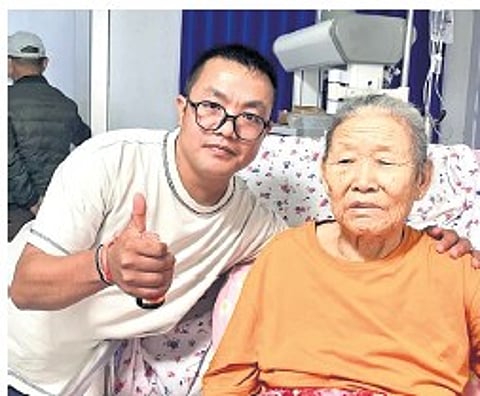
He also provides medical care to elderly people who get abandoned by their children, ensures free education for orphaned and underprivileged children at a local school, and collects unused medicines from households so that doctors can distribute them to the patients who are in dire need of them.
Reflecting on his potential defence career, Jeke says: “The hardest part in NDA is clearing the written examination. I could have possibly cleared the SSB interview and the medical test as well. But I have no regrets. I was perhaps destined to serve society this way.”
He says his parents—who once told him that if he wanted to work for society he should also beg from society to support himself—now beam with pride when they talk of his work. He adds that the support he has received from peers and well-wishers has kept him going.
His life shows that when a person works with compassion and determination for a noble cause, he or she can transform an entire society.