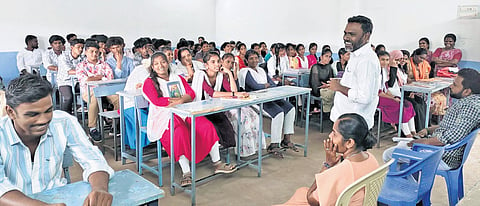

DINDIGUL: A silence hangs over many village classrooms, children return home with bags on their backs and heaviness in their hearts, as teaching is limited to only what is ‘necessary’, laws are nothing but words, and action is fictional. In dusty courtyards and under the flicker of a single tubelight, questions bubble up to the point clarity can feel like a rescue from a lifetime of fear for these children.
Into that space steps Su Manikandan. A 44-year-old man clad in a lawyer’s suit by day, has spent countless hours in government classrooms across Dindigul, translating legal texts into that lifeline. After more than 250 awareness sessions, thousands of women and children, who would otherwise have been kept from knowing the very laws that protect them, have been equipped to stand their ground.
After his schooling, his grandmother, Kamatchi, became the compass that directed him toward social work. A midwife with no formal schooling, Kamatchi went out of her way to help pregnant women in the village. “Regardless of rain, scorching heat, or the time of day, my grandmother travelled to the homes of expectant mothers. The entire village deeply respected her. She was a one-woman army and showed me that while education is important for personal growth, acts of social service hold even greater value for the well-being of society,” he says.

Manikandan stepped into the Gandhigram Rural Institute, enrolled in a BA social work course, and graduated with a gold medal, but a different calling knocked – law. The nudge to pursue law came from his senior professor, R Mani, who saw in the young social worker a courtroom presence he had not yet seen in himself. “My professor pointed out my abilities and strong public speaking skills, and their significance in a legal career,” Manikandan says. Heeding the advice, he secured admission to the Government Law College in Madurai, and later assisted senior advocates in Madurai courts.
As Manikandan moved on to preside over cases in Nilakottai and Dindigul, he did not let his briefcase eclipse his social-work calling. It began, he says, with a simple observation – ignorance among rural communities about basic laws. “If they are aware of their rights, they can protect themselves from exploitation and become responsible citizens.”
Armed with a circle of like-minded friends, he walked into a government school 12 years ago. He held his first session – not a lecture but an “awareness exchange” – where he spoke about child labour laws as a shield for children whose childhoods were being traded for survival. “If sessions are run like traditional classes, children lose interest,” he says. His method instead invokes questions, and comes with practical steps they can use the same week. This approach has produced moments that model his sessions.
Holding up a mirror to poverty’s logic, a Class 11 boy told Manikandan that working to contribute to the family income was inevitable for him. In response, Manikandan said, “Education can break the cycle,” and suggested education as a ladder out of that generational poverty.
Another such encounter came during a Pocso Act awareness class when a Class 12 student mentioned to him about a friend who loved sweets, an ordinary detail, until she added that a neighbour who gave her sweets had used them to manipulate and abuse the friend. “I was shocked,” Manikandan says. “It occurred to me that she might actually be the victim in that story. Young girls often find it difficult to express their distress openly.”
Under MGNREGA, many women, single and widowed, between the ages of 30 and 40, face harassment from local officials. A 30-year-old woman once said during his session that a panchayat secretary was sexually harassing her. Manikandan steered the conversation towards actionable steps through the women’s helpline, police, and free legal aid. “This work is government work, not a favour,” he reminds the women. “The law stands with you.”
Stripping away legalese, session after session, Manikandan paints the fears haunting women and children with information. The granular impact his social empathy leaves behind in each of these exchanges coalesces into a community reclamation project. A girl no longer saves a secret, a boy chooses to stick to a path of schooling, and a widow learns to demand dignity. And so he continues, carrying justice like a lantern through Nilakottai town – small, steady, and impossible to ignore.