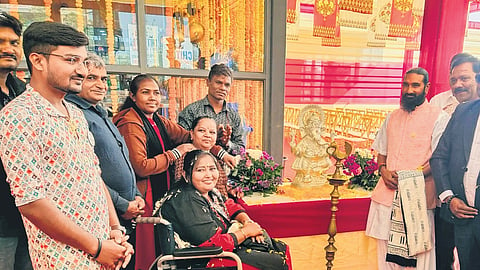

GUJARAT: At 17, Nita Panchal lost her ability to walk when the 2001 Gujarat earthquake reduced her world to rubble. Trapped beneath a collapsed building, she survived severe spinal injuries, 35 surgeries, depression and a broken engagement. More than two decades later, the wheelchair user has turned her personal tragedy into a campaign for disability rights, helping hundreds of women reclaim their dignity, independence and place in society.
Born on January 12, 1983, to farmers Govind Patel and Ganga Patel in Dudhai village of Kutch’s Anjar taluka, Nita was a Class 10 student when the earthquake struck on January 26, 2001. Buried under debris, she suffered a spinal cord injury that left her permanently paralysed from the waist down, with 95 per cent disability.
The disaster also destroyed her family’s home and belongings and claimed loved ones. What followed was a prolonged struggle involving hospitalisations, rehabilitation and repeated surgeries.
Initially, Panchal believed she would recover. After more than a year of treatment, however, she had to accept that she would never walk again. Depression followed, compounded by social prejudice. Her engagement was called off after the prospective groom’s family learnt about her disability.
A turning point came when her brother introduced her to the film Naache Mayuri, based on dancer Sudha Chandran’s struggle after losing a leg. It encouraged her to reconsider her future. “If I have to live, then I should live with a smile,” she recalled telling herself.

Determined not to remain dependent on others, Panchal started a small imitation jewellery business and later opened a PCO to support her family. She also took up wheelchair racing, participated in national-level competitions in Bengaluru and won medals.
Her personal life changed when she met Parag Panchal through rehabilitation-related work after the earthquake. Both were persons with disabilities. Despite opposition from their families, they married in 2006 and later welcomed a son. Following her marriage, she settled in Ahmedabad.
Her experiences shaped a larger mission. Panchal realised that thousands of women with disabilities faced similar discrimination, dependence and denial of opportunities. “You move forward in life with your intellect and thoughts, not with your legs,” she said.
For Panchal, empowerment means equal rights and independent decision-making, not charity. She mobilises donations to help women become independent. Travelling in her wheelchair to remote villages, she meets women with disabilities and their families, explaining government schemes, legal entitlements, education and livelihood opportunities. .
Her interventions have helped more than 250 persons with disabilities secure employment through advocacy with agencies, while over 350 women have received livelihood support. She has encouraged more than 80 girls who had dropped out of school because of disabilities to resume studies.
Panchal believes discrimination often presents a greater obstacle than disability itself. Further, her campaign extends to healthcare and accessible public infrastructure. She regularly visits government hospitals to highlight barriers faced by women with disabilities seeking medical treatment.