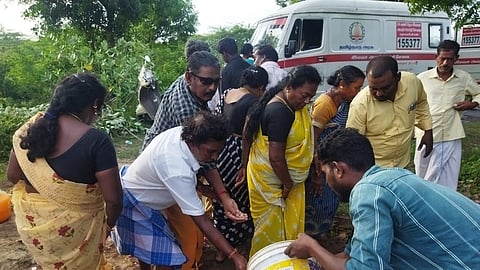

NAGAPATTINAM: The stray dogs came first. They were dragging at the remains of a person buried barely two feet beneath the earth in a crematorium an unexpected visitor had entered by chance. There was no name to call, no family to inform, and no hand to hold in farewell; only a body the world had already begun to forget.
For the man watching, the sight did not simply disturb him. It unsettled something deeper — the belief that death, however lonely, should never strip a human being of dignity.
Fifteen years later, S Rajendran, now 70, has performed the final rites of more than 3,500 unclaimed and unidentified bodies across Nagapattinam district, largely at his own expense. He has become, in effect, the last relative to people who died without one -- the person who answers the call, brings the body home to a burial ground, and ensures that it is laid to rest with care rather than treated as refuse.
His resolve came after a series of encounters that refused to leave him. Along with the image of stray animals disturbing a shallow grave, he had seen unidentified bodies being transported in garbage trucks. The thought that a human body could be treated with such indignity troubled him.
Since then, Rajendran has responded to calls about unclaimed bodies from across the district. He arranges for them to be brought to a burial ground in Nagapattinam and performs the last rites, irrespective of caste or religion. In a landscape where death often arrives without warning and abandonment without apology, his work has become a quiet act of resistance.
The bodies he encounters carry stories of lives that unravelled quietly. There are elderly people who died alone after falling ill and people who left home and never returned. Some died in hospitals. Others were found on roadsides or in public places. Many had no relatives to claim them, and no one was willing to bear the cost of a funeral.
For Rajendran, however, the absence of a name does not diminish the weight of a life. He performs the rituals with the care and attention a person would receive from their own family. His small office in Nagapattinam is stocked with clothes, incense sticks, camphor, sacred ash, rose water and other materials needed for the ceremonies — a modest armoury against indifference.
His service has also reached families who cannot afford the expenses of performing the last rites for loved ones. He steps in, meets the cost, and asks for nothing in return.
The commitment has come at a heavy personal price. Residents say Rajendran has sold his own assets to sustain the work, and has not relied on donations. He does not seek payment or financial assistance from the families he helps. What he seeks, instead, is an agreement that he alone will pay for the final rites. It is a bargain with grief, made on his own terms.
Despite his strong faith in God, Rajendran insists that the work has nothing to do with earning divine rewards. “What kind of human being would I be if I did these things expecting heaven or something in return?” he says. “If we do good deeds with expectations, it makes us all just opportunists.” Then, with the simplicity of a man who has spent years standing beside strangers at the edge of death, he adds, “I have money, and I have a heart. That is more than enough to do all this.”
Rajendran has also been involved in building temple ponds and organising consecration ceremonies. Yet, he says the satisfaction he derives from performing the last rites of abandoned people is greater than anything he has experienced through those activities.
For Rajendran, the purpose remains straightforward. Those who may have been forgotten in life should not be forgotten in death. In a world where even sorrow can be divided by caste, class and circumstance, he has chosen a simpler belief — that every human being deserves a farewell, not because someone knew them, but because someone, at the very end, chose to care.
