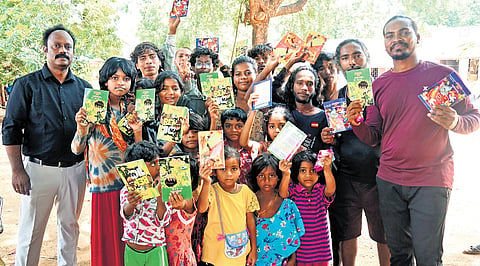

TIRUPATTUR: “O…n…dru…ondru, e…ran…du…erandu, m…oon…dru…moondru…” goes six-year-old Maisamma all the way to “paa…ithu…pathu”, jumping with joy as she reads aloud from her kanakku (math) book, practising counting from one to 10. Saravanan watches, his face glowing with pride at her small win, as her family claps along.
Saravanan (44) has been a government school teacher for 20 years. Hailing from Ambur in Tirupattur district, he has earned several accolades for his commitment to education. In 2025, he was among five teachers from Tamil Nadu shortlisted for the National Teachers’ Award. In recognition of his work, the National Book Trust of India gifted him 250 children’s books worth Rs 10,000.
It was his wife, Shalini, also a government school teacher, who suggested that he donate the books to children in the nearby Narikuravar settlement, home to one of the many marginalised tribal communities that continues to battle discrimination and exclusion in all spheres of life. Some of her students come from the settlement. “I decided to take the books to these children,” he says.
The enthusiasm with which the children took the books made him wonder – what if the books came to them? And just like that, an idea of a mobile library began to take shape. Since then, Saravanan has clocked hundreds of miles, carrying a small box of books strapped to his motorcycle as he travels to tribal settlements.
On reaching the Periyankuppam settlement, vague silhouettes of people begin to emerge in the horizon. As he draws closer, they slowly come into focus, their faces revealing shining eyes and warm smiles. The children come running at the sound of the engine and the beep of the horn. Maisamma, Thavasi and the others swarm around Saravanan’s black Dio before it even comes to a stop. To the children, the box is a little like a magician’s hat.

Saravanan takes out a bundle of kanakku notebooks, printed with bright Ben 10 and Angry Birds pictures on the cover. A child shyly steps forward and asks if he has any kadhai (story) books. He looks into the box and hands her a Tamil storybook from the Thumbi series. The box holds a little of every world. “The idea is to stretch their horizons a bit further each time,” says Saravanan.
However, for Saravanan, bringing books to the settlement is only a beginning. Beyond it lies a larger challenge: keeping children in school and ensuring they have the freedom and support to learn. Over 13 kids aged six to 14 attend the Periyankuppam government primary school. About 10 others are aged 15 to 18; a few attend the Concordia government-aided school in Ambur, while the rest have dropped out.
Sakthivel, a resident of the settlement, says the distance to school was once a major obstacle. Children had to walk 5 km to get there, resulting in many dropping out. “But now volunteers have arranged an auto for the children,” he says.
For girls, the barriers extend beyond access to education. Madhubala, Sakthivel’s wife, says conservative attitudes within the community restrict women’s freedom. “Women in our community aren’t even allowed to sit with their legs crossed,” she says. After a thoughtful pause, she adds, “But my daughter will see that change.” She hopes her child could continue her education even after attaining puberty.
“We still have a long way to go,” Saravanan says. “First, we need to organise the younger members and the parents of the community and emphasise the importance of education. After that, my main goal is to establish a physical library for the children here, providing them with a safe space to read and learn, along with career guidance for their future.”
As Saravanan prepares to leave, he asks Thavasi about school, tightening the strap to his seat. “I haven’t been attending school for a year, sir. I was in Class 9, but I stopped going because my friend Manikandan isn’t coming to school,” Thavasi replies.
“Manikandan, Thavasi, Class 10 is very important. You’ve come this far. Don’t give up, pasangala. If I enrol you both in Class 10 next academic year, will you study?”
“Yes, sir, we will study,” the boys reply.
As Saravanan kicks the engine to life and the bike eases forward, in a small round mirror he catches sight of adults and children, watching him go — their hearts holding on to the unspoken promise of his return, new books and fresh possibilities waiting to arrive on his motorcycle. He lifts his own hand in promise and farewell.