
TIRUCHY: Surrounded by hills and rocky outcrops, the outskirts of Mannaparai are dotted with small places of worship, old sculptures and inscriptions worn down by time and neglect. Not too far away, at the Government Arts and Science College in Manapparai, Tiruchy, A Selvaraju, a faculty member in the Department of Tamil Studies, is making sure that his students don’t walk past them the way everyone else does.
It all began one ordinary day during a lecture on Tamil history. “When I spoke about the history of the region in class back in 2024, students began telling me about sculptures they had seen in their own villages. That made us think of studying them through field visits,” says Selvaraju.
And just like that, one field visit led to another. More often than not, the team stumbled upon remarkable finds in the area. One of their earliest discoveries came when Gunasekaran, an undergraduate student in the department, mentioned a sculpture in Idaiyapatti. “This prompted us to visit the site. During the field visit, we identified it as a Jain Tirthankara sculpture, dating back to between the 8th and 10th centuries. Two other damaged sculptures were found hidden inside thorny bushes. We also came across what I believe to be remains of a buried Jain monastery,” Selvaraju said.
Tasting success early on, the group now ventures out once a month, chasing down the stories in their own backyard. In Mottai Malai near Marungapuri, the group found damaged sculptures, along with evidence suggesting that the hill may have once been associated with Jain habitation.
At Perumalmalai, near Puthanatham, the students documented a damaged and incomplete inscription on a stone pillar. Their work also took them to Keelapoigaipatti, where they examined a dilapidated Siva temple and found inscriptions around the structure and its surroundings. Selvaraju said the inscriptions appeared to belong to the later Chola period.
For the professor, however, the discoveries are not isolated finds but pieces of a larger archaeological puzzle. “Studying these findings could reveal more evidence on the spread of Jainism in regions like Madurai, which is believed to be the cradle of the ancient religion. Even names of some places appear to have connections with Jain traditions. Our aim is to bring such evidence to light,” he said.
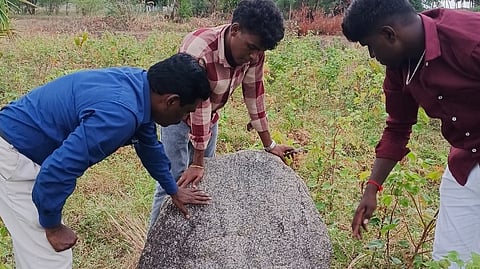
On August 24, the group’s latest find came at Kallamedu village after R Bhoopathi, a first-year BA Tamil student, mentioned a carved stone lying in her uncle’s agricultural field. On visiting the site, Selvaraju and his students unearthed a striking discovery: three hero stones standing in a cotton field. Selvaraju noted that each stone depicts the same warrior, with his right hand raised and holding a sharp weapon, and a bow in his left hand. The warrior’s legs are carved in a posture suggesting he is drawing or shooting an arrow. The stones are about four feet high and three feet wide, with their lower portions buried in the soil.
Selvaraju said finding three hero stones depicting a single warrior was unusual. While many hero stones found in Tamil Nadu commemorate warriors who died protecting cattle or fighting wild animals, the exact circumstances surrounding the Kallamedu warrior remain uncertain. No name or inscription is visible on the exposed part of the stones.
Selvaraju stated that the previous year, through the Tamil department, they had compiled and published a collection of poems written by one of their students. He added that they had also composed Oppari, which are traditional songs for the deceased sung in parts of Manapparai, and had published them under the title Oppari Paadalgal.
Whether it’s a forgotten inscription or a folk song passed down through generations, Selvaraju’s interest lies in preserving what might otherwise be lost. Not exactly Hollywood-style, fedora-clad, bullwhip-wielding Indiana Jones, yet no less iconic to his students, Prof Selvaraju is a member of a dying breed: a teacher who takes students beyond memorising dull lists of dates and names, encouraging them to look at the landscape around them and discover the history hidden in plain sight.
