
HYDERABAD: For urbanites, a stroll in the woods can be highly de-stressing and refreshing. If it is a guided walk with a local, it turns even educative. We often hear of tribes/indigenous groups who are mostly hunter-gatherers living in the forests, depending totally on forest produce for their everyday existence. These are the true children of the forest who know how to survive under the direst circumstances. Well, I had an insight into their lives recently in the Philippines, during a forest trail in Pamulaklakin Forest in Subic Bay Freeport, Zambales. This was right after my exhilarating experience in the Puning Hot Springs.

Mount Pinatubo, that erupted in 1991 made the entire region quite fertile including the Pamulaklakin forest, which is inhabited by the Aetas. Aetas are an indigenous people who live in scattered, isolated mountainous parts in the Philippines.
Thought to be among the earliest inhabitants of the Philippines, they are of small stature with a light frame, dark brown skin, kinky hair, a small nose and deep brown eyes. Nestor, an Aetas, took us on a long trail in the forest, revealing different herbs and trees, and their uses. It was a fascinating trek crossing small streams, going over bridges, walking through thick woods and climbing mildly steep hills.
He showed us the Vinegar Leaf that is used in cooking, which indeed tasted sour. Then he pulled out some herbs that cure kidney stones and diabetes. Later, he took the bark of a tree, crushed it and rubbed it between his palms with a bit of water, working into a rich lather.
Yes, that is what they use for washing their hair. When they are thirsty, they go to a particular tree; cut a branch, from where oozes water. We all lined up to taste as if it’s the divine nectar, though what each of us got was a mere drop.
But that drop makes a difference when you are thirsty! He took us to a liana (woody vine), cut a long piece, made fine strands out of which he made a thin but strong rope by twisting them together; then he tied it to a bow as a bowstring. It is the same vine what we call Rattan, well known for its use in furniture and ropes. He also made a couple of traps with the same vine that is used to catch jungle fowl and monkeys. Of course, they do eat monkeys (and many other small animals).
Meanwhile, a woman came to us holding two bamboos: one had rice in it while the other, some reddish gravy. Nestor said they use bamboo as containers to cook rice and curry. We stopped at the Balete tree, which he identified as a strangler fig. They are notorious for starting upon other trees, later entrapping them entirely and finally killing the host tree: they played a great role in destroying temples in Angkor Wat in Cambodia.
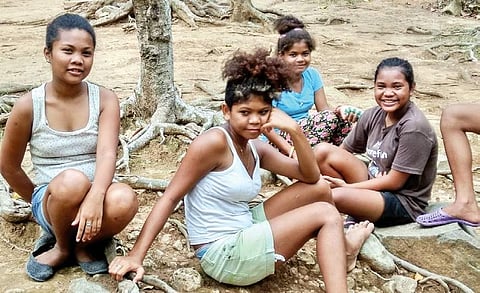
The locals believe that spirits reside in the Balete tree. On the way, I met a group of young girls, dressed in shorts and T-shirts like any modern youngsters. They all study in nearby schools and can communicate in English.
The forest trail was followed by an amusing jungle survival exercise that was like a stand-up comedy show. Tata Kasoy, one of the elder members of the Pastolan Tribe of the Aetas, is very theatrical and adds a lot of vitality to his performance. He was born under a cashew tree, hence the name Kasoy (means cashew in their language).
Clad in a loincloth (the Ayta traditional clothing: the bahag), speaking broken English, Tata Kasoy indulged in melodrama, at times going overboard. He demonstrated how to craft a spoon, a fork, a cup and a container to cook, all from bamboo, using only his handy knife: in fact, he produced a whole kitchen just with a single trunk of bamboo; then cooking rice with a section of the bamboo stem, and pretending to eat in between. Finally, he showed us how to make fire with only dried leaves, wood shavings, and friction from the bamboo.
He flipped the bamboo, scratched off thin strips off its outer skin using his sharp machete, then clumped them together and started vigorously rotating a small piece of wood over it. Seconds later smoke emitted from his work and fire eventually flared all over the bamboo strips. Though I watched ethnic groups making fire earlier, Tata Kasoy’s zeal made it a memorable experience. Later, the diminutive Casanova took pictures with all ladies, striking romantic poses, much to everyone’s amusement.
On our way back, we went to the Ocean Adventure – a marine conservatory and adventure park located in Subic Bay. Watching the sea lions fly through the air, glide around the stage, and perform some rare feats provided a lot of mirth to families visiting with kids: at the same time teaching them how to protect marine and wildlife resources.
At the end of the day, I realised how fulfilling was my experience. Seeing rain forests is different from watching from close quarters, how these indigenous guardians hold the jungles close to their heart, taking only for their needs and protecting them from the civilised man’s greed.
(The author is a documentary filmmaker and travel writer; she blogs at vijayaprataptravelandbeyond.com)