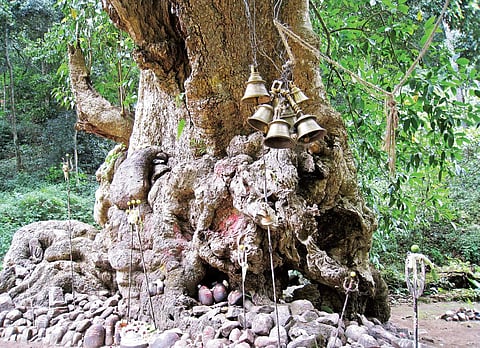

HYDERABAD: I was curious about this tree and really wanted to see and touch it: a thousand year old Michaelia Champaka tree that is still flowering! It needed special permission to pass through the core (most) area of the forest – the manager (of Jungle Lodges and Resorts – K Gudi, where I was staying), very enthusiastically arranged for it. So we went, five of us, including the young jeep driver who mostly freaked out at the wheel. Lokesh, the naturalist and a teenage probationer at the back, me in the middle, manager in the front, navigating. I can never forget that journey.
We passed through the most beautiful part of the jungle – an evergreen forest, which is 6,000 ft above sea level. Forest so thick, green and impenetrable, it felt like a different world. Countless butterflies kept us company, fluttered along the safari jeep, as if they were taking us in a procession.

Resort manager was giving me all the information. Locally called Dodda Sampige Mara, literally, The Big Champaka tree is worshipped by the Soliga tribe as Mahadeshwar. It is their sacred grove. The BR Hills link the Eastern Ghats and the Western Ghats allowing animals to move between them and facilitates the gene flow between species in these areas.
The valley reverberated with the cicadas singing. Tall trees, some of them more than 100 years old, were vying with each other to reach the sky. As the local tribe Soligas live in this area, their settlements were all on the hill, close to the tree.
I saw them cooking and going about domestic chores on the hill slopes. They collect forest produce like gooseberries, honey, and lichens (a combination of algae and fungi that grows on the tree barks in these regions - it is used as a spice). During coffee harvesting season, they work as field hands to earn some money. Some own small pieces of land, where they grow coffee. Most of their children study in tribal hostels run by NGOs.
They have great reverence for this tree and every year in the month of April, celebrate the annual festival, Jatra when they perform the fire dance around the tree. This falls mostly just before ‘Maha Shivarathri’ festival.
The tree was huge, with absolutely green and abundant foliage. Having witnessed a thousand years, the tree has acquired a mystical aura and was simply overwhelming to behold. The base was gnarled and enormous, having sheltered thousands of birds; blossomed millions of champaka flowers in its branches; witnessed endless cycles of life around.
It stood there, proud and wise with age, enormously tall, next to a stream like river Bhargavi, a tributary of the Kaveri. Parasurama is said to have washed his axe in this river after slaying many Kshatriya rulers, who strayed from the path of dharma. Soligas believe that this tree was planted by sage Agastya 3,000 years ago. The river Bhargavi nearby is said to be the form of Renuka, mother of Parasurama and wife of the great sage Jamadagni. All these legends further added to its aura.
Resort manager who had seen the tree in bloom during the season, which is around April, was describing the flowers - yellow orange (peach colour), and cream colour fragrant Sampge blossoms; reeling out details like its botanical name, Michaelia Champaca and the tree statistics etc., but nothing mattered to me. It was standing there, magnificent with an imperial air. My thoughts wandered and I imagined hundreds of these flowers on the tree and mentally inhaled the heady scent.
Champaka flower is commonly called the Joy Perfume tree. This delightfully scented flower comes in two colours, is used often in worship. Specially grown in temple precincts, it is considered particularly sacred to Krishna. It forms one of the five flower-darts of Manmadha (Cupid). Champaka flowers along with Ashoka and Punnaaga adorn the locks of the Mother Goddess Durga. These celestial links make the flower all the more divine. Poets celebrated its beauty.
Kalidasa addressed a beautiful woman who rejected his advances thus, “O Beauteous One! Maha-Brahma has formed thy eyes with lilies, thy face with lotus, thy teeth with white lilies, thy lips the tender leaves of a na tree; and thy limbs with the petals of the champaka. How is it that thy heart alone is cast in stone?”
At the foot of the tree there were a number of small lingams, most of them smeared with vibhuthi ( holy ash). There stood some tridents with lemons pierced onto them, and a bunch of brass bells hanging. Going around the tree, I peeped into the huge tree hollows which looked like possible dwellings of elves. There was an interesting grinding stone standing nearby. Lokesh said it is used during the festival feasts. I duly photographed it.
Dodde Sampge Mara has a younger sister nearby, called Chik Sampge Mara (Small Champak tree). The rarely used route to this tree was very narrow. We had great difficulty in reaching the location. In fact, we had to stop the vehicle a couple of times, to clear the way. This is another splendid tree, may be 800 year old with an impressive trunk and great height and still flowering. Jatra for this tree is celebrated in March. Soligas in large numbers assemble for both the festivals of the sister trees.
Yes, I will wait for the spring, to come again, pass through the lovely, deeply wooded impenetrable forest, and feast my eyes on the grand dame bejewelled with countless champaka flowers and carry back with me, the fragrance and the joy. (The author is a documentary filmmaker and travel writer; she blogs at vijayaprataptravelandbeyond.com)