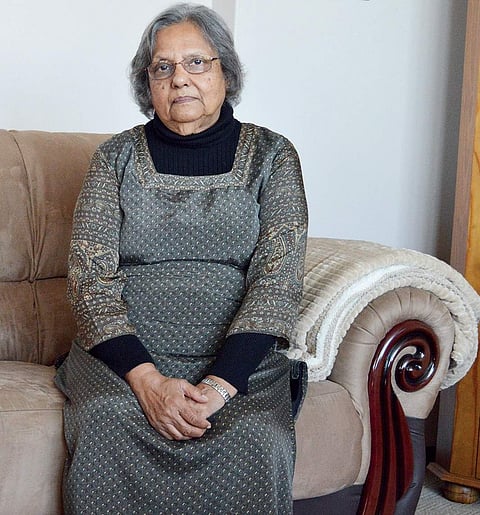

HYDERABAD: After the sumptuous breakfast, over coffee, I broach a topic that seems to be her favourite: I often see people getting nostalgic when they go back in decades, digging into one’s early years full of innocence and carefree childhood. I want to know the earliest memories of her famous grandfather. Her face lights up as she goes back many decades.“I was only seven years old when I first met him. My parents went to India during 1946-47 and we spent about three months in his Sevagram ashram when we had a quality time with him and bonded. He used to give us at least an hour each day when we children, could sit with him and hear little stories.
It was a time when he was the busiest and saddest as the Hindu Muslim riots were taking place: by then the Partition was decided and the Constitution was being drawn. In spite of his busy schedule, he had time for us. And when we returned around December 47, by January he had written two letters to me. To think that he could write to a seven-year-old only showed his absolute interest in us, his grandchildren. He used to give us undivided attention: when he spoke to us, it was not the flippant

conversation but always a meaningful discussion.
Even as a seven-year-old, I was inspired by two of his teachings - that of truth and repentance. If I have to cite an example, it happened in 1948, after we came back from India. Sugar fields and farms surrounded the Phoenix Settlement where we lived. One day, when my parents went out and I was alone at home, a huge crowd from the community came to me; there was a wildcat on the tree opposite our house and a farmer was concerned that the cat would eat away his chickens.
He wanted to kill the cat but wasn’t allowed to use the gun on the Phoenix Settlement. He asked me for permission to use the gun to kill the cat. Being an eight-year-old, I said, “Ok, kill it.” Because I was scared too as they told me that the wild cat was going to bite me. They killed the cat with the gun and left. When my parents returned, I told them what happened. My mother made me understand how wrong it was to give permission to kill a cat. That is when I realised my mistake and cried. My mother said, “You don’t have to cry but repent and ask God for forgiveness. And remember not to do it again.” So I decided at that age, on my own, that I would fast for a few days.”
“One day we were sitting and talking when I said to Bapuji, “You should not call this Sevagram but you should call it “kola gram” (kola is pumpkin in Gujarati). He laughed and asked, “ Why are you saying so?” I said, “We eat only pumpkin here day and night, that’s why”. When he went to the prayer meeting that evening, he announced, “ A child told me (he didn’t mention my name) that every day they serve pumpkin here. You should have variety, eat all vegetables, why do you make it difficult for people by giving them pumpkin every day”?
He gave so much importance to a child’s opinion though he had more serious things to think about: it was a time when he was busy in serious discussions with leaders like Jawaharlal Nehru and Vallabh Bhai Patel.” Gazing at the panoramic view of Durban, from the huge glass window of her 12th floor home, she says wistfully, “ I don’t have any memories of my grandmother as she passed away when I was four or five. I feel that Kasturba, in particular, was not given the importance that she deserved. There are no books on her or records that spoke about her contribution, but Bapuji said that he learned ‘how to be brave’ from her. She was courageous, stubborn, and didn’t always obey him. She was never meek, as was perceived. He writes in his book that he used to want to dominate her, but she would never allow that.”
As we go through the historic photographs displayed on the walls, she remembers each one with fondness, pain, and nostalgia: her parents, her sister Sita Gandhi, significant moments from the freedom struggle etc. We talk of the sad Partition. I wonder if India and Pakistan can ever be friends again. She reassures, saying, “If there is hope for Palestine and Israel, why not for Pakistan and India?”
Two of her children live in Durban (a son and a daughter) while the other two daughters live in Johannesburg and Pretoria. “Everyone is settled down in SA, which is good. My son Kidar always loves to go to India,” she says with a smile.
“I feel that I have two homes: South Africa and India. In 1947 when I was in Akola in Maharashtra, a small town, I was asked to raise the Indian flag in my school. I still remember, as a seven- year- old, I raised the flag and sang ‘Jhandaa Uncha Rahe Hamara’. When it comes to South Africa too, I feel the same patriotism. So, my love is for both the countries.” Yes, while one gave her the roots, the other gave her space to grow. Here or there, what she proudly cherishes is, being a Gandhi.
(The author is a documentary filmmaker
and travel writer; she blogs at www.vijayaprataptravelandbeyond.com)