
HYDERABAD: As my journey continued from the ancient Kolanupaka to Warangal, the next two hours I spent thinking of the magnificent Kakatiya period in our history. Orugallu (present day Warangal) was the capital of the Kakatiya Dynasty that was established in 1163. The beautiful monuments left by the Kakatiyas include majestic fortresses, temples and stone gateways, which have earned Warangal a prominent place in the tourist map of Telangana. No wonder, Warangal is also a three-time winner of the best heritage city award!
Soon I checked into Haritha Kakatiya, the hotel that gave me maximum comfort during my stay and made my visit memorable. Good hotels do matter, don’t they? After a sumptuous lunch and siesta, off I left for the famous Warangal Fort. The warm golden rays of the evening sun further enhanced the charm of the ruins. These ruins speak volumes of the glory of Kakatiyas, which inspired Marco Polo, the famous Italian traveller to praise the rich culture and the administrative excellence of the Kakatiya kings.

Fort
The Kakatiya King Ganapati Deva built it during the 13th century when the capital was shifted from Hanamkonda to Warangal. Later his famous daughter Rudrama Devi completed the structure. The last ruler, Prataparudra II, added significant features to the fort. During his time Malik Kafur attacked the fort with a huge army in a battle that lasted for many months, destroying large parts of the fort. Subsequently, it was ravaged during many attacks by various Delhi sultans. The remains of the main fort are in ruins but one can see the amazing craftsmanship and artistry in the sculptures.
The imposing fort was built in three layers of fortification, ensuring absolute safety. The first is an earthen wall surrounded by a moat, the second wall, made of granite stone using interlocking system eliminating binding material. The third wall is made of mud encircling the present Warangal city. Oblivious to the historical importance of their neighbourhood, the people living in the fort area go about their daily chores.
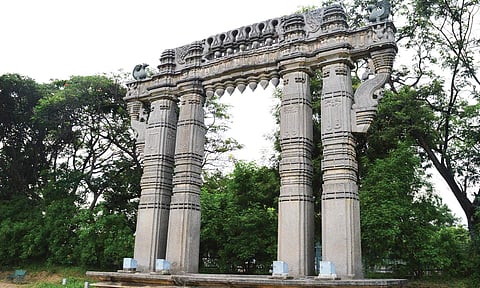
We can still see some of the gates that lead to the central part of the fort (archaeological zone). The most iconic part of the ruined fort is the celebrated Keerthi Thoranams or the gateways. Each of them has four massive pillars that have been carved out of a single rock. These majestic gateways (30 ft high) represent South Indian architectural style, with swans adorning them. The richly carved pillars of some ruined temples lay scattered around. Among them are temples dedicated to Mother Earth (built by Qutb Shahi kings) and Lord Shiva, with exquisite carvings.
The “Sound and Light Show” at the fort was a beautiful experience that transported me to the Kakatiya era, with drama, dialogues, music and suggestive lighting that played with my sentiments. We were only five people in the audience including a couple: the man speaking loudly on the cell phone while the woman engaged constantly in texting and meddling with the mobile. Wonder why people come to such places if they are not interested in knowing about them! Besides disturbing others, isn’t that insulting the solemnity of the place?
The next day morning I went again to the fort, to see and capture it in a different light. What I saw was even more beautiful in the morning sun! It made me sad to see the intricate carvings broken at many places-especially human figures, more so, the dancing girls.
Khush Mahal
Right opposite the fort is a well-preserved elegant edifice, built by Shitabh Khan, the 16th century Qutb Shahi governor of Warangal. It is a mute testimony to the glorious past of Warangal. The idols excavated from surrounding area are displayed here. As I was going around, a man came forward and directed me to the statue of a seated bull, the Kakatiya nandi and enlightened me on the significance of the posture, which I found to be interesting.
Bhadrakali Temple
As per the writings on the temple wall, King Pulakeshin II of Chalukya Dynasty had built this temple in 625 A D to commemorate his victory over Vengi region of Andhra Desham. Later the Kakatiya kings adopted the temple and considered Goddess Bhadrakali as their family deity. King Ganapati Deva dug a lake adjacent to the temple. Due to the fall of Kakatiya dynasty to the Muslim rulers of Delhi, the temple lost its prominence. In 1950, Sri Ganapathi Sastri renovated the temple, along with the help of affluent locals.
Thousand Pillar Temple
This awe-inspiring creation by the Kakatiya Vishwakarma Sthapathis (temple architects) is one of the many Hindu temples that were developed under the patronage of the Kakatiya dynasty. Supposed to be constructed from 1175–1324, this masterpiece, like many other temples in South India, was vandalized by the Tughlaq dynasty during their invasion of the Deccan. The temple is star-shaped with three shrines dedicated to Shiva, Vishnu, and Surya thus earning the name, Trikutalayam. Constructed on a raised platform, the rock-cut elephants and perforated screens in the temple reflect the Kakatiya architectural style.The highly polished black basalt monolith nandi, that has witnessed the good and bad times for the last ten centuries, patiently bears all the damage that is caused when people sprinkle adulterated haldi and kumkum on its glistening body. That is, after they finish taking selfies with the black beauty!
(The author is a documentary filmmaker and travel writer; she blogs at vijayaprataptravelandbeyond.com)