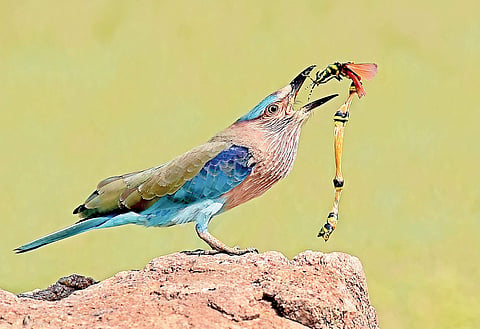

HYDERABAD: As a hardcore bird-lover I have always been seeking out and feeding birds. And also writing about them. Even choosing (in my work as a translator) to translate books on birds. Also, in what is the best part, doing as much birdwatching as I can. So I have seen birds whether in the famous Indian bird sanctuaries at Bharatpur and Ranganathittu; the penguins at Philip Island in Australia; the varied avi-fauna in Kenya, South Africa and Mauritius and also wherever I could find birds in Asian and European countries.
However, it must be pointed out that the bird population has reduced considerably. There would have been more places on this list. Even the ones on the list present a depleted green cover. This is because many green areas have fallen prey to urbanisation and development activities. Encroachment for building projects or infrastructure, has taken a heavy toll as has the loss of green cover because the area has been converted into a sewage or garbage site. Another problem is the landfills. So, even within the places where greenery has survived and birds are found in abundance, the present areas are actually shrunken from what they were decades ago, the avian population is a reduced number.
This is indeed a great pity as birds are not just there for us to watch or photograph them and enjoy their beauty. Birds have a highly important role in nature. They are major forces in maintaining biodiversity, and keeping our environment green and clean and thus our own bodies and minds healthy.
As G Sailu, state project coordinator, Telangana State Biodiversity Board, explains: “In nature, birds are really special. Birds are important to the maintenance of a rich biodiversity. By a natural mechanism, they spread the seeds of various plant species which have a viable germination thus increasing green cover and preserving plant varieties. In layman’s language, they select a particular fruit and eat it and fly away and throw the seeds around in different forests, gardens and grounds when the seeds come out through the excreta. Also, it is bird and butterflies which are responsible for pollination and if we are getting fruits today it is because of this function or work of theirs. No artificial mechanisms can replicate what the birds do for us. Also, just looking at birds improves our mood, relaxes us and uplifts our spirits. Unfortunately, today, we are losing our birds.”
I have also realised that to enjoy birdwatching one need go as far as the above countries---there are plenty of avi-fauna watching opportunities in and around our very own Hyderabad. There are many parks, lakes and campuses where one can spot birds in and around the city. There are hundreds of species of birds in these places and the bonus is that you will often, also find a big number of butterfly species around. Here is a list of birding hotspots in and around Hyderabad where you can spot birds and shoot all the pix you want too--though there are restrictions on photography at certain places:
Sanjeevaiah Park
If you are talking of a central area, this is the best place within the city to spot birds. Mercifully, it has not been run over by concrete or industrial waste. There are over 100 species of birds and 40 species of butterflies to be found here. There are also eight to nine species of mammals here. The water-body here attracts a lot of migratory species.
Ameenpur Lake
In recent years, it has acquired some kind of celebrity status after being declared a Biodiversity Heritage Site---in fact, this is the first wetland in India to be so declared. In recent years, the lake has seen a few clean-up operations by citizen groups and NGOs and adoption of the lake for conservation by Tejdeep Kaur Menon under the Kakatiya Mission. The lake and the vegetation around attract over 223 species of birds including flamingoes, pelicans, Asian Openbills, Painted Storks, kestrels, kingfishers, bee-eaters, hoopoes, pelicans, spotted owlets, etc. Snakes also abound in this area.
Botanical Gardens
Not many among the average citizenry know of this place. Of course, one does find groups of school students being taken there for excursions and study trips. This was once a fairly large forest reserve and has now shrunken in size. Nevertheless, it is still a great place for birdwatchers given the approximately 600 species of plants and several ponds and watering holes. Plenty of butterflies are also found here thanks to the abundance of medicinal plants. Look out for minivets, flycatchers, orioles, Baya Weavers, kingfishers, spotted owlets, etc.
Edulabad Lake
Every time I have visited this place I am saddened by the extent of the pollution--mostly industrial effluents. In some parts, it reminds you of the infamous frothing lakes of Bangalore. A very small number of birds have survived---- storks, kingfishers and several migratory species.
Nehru Zoological Park
People tend to believe that because this is a zoo, the only birds one would see are caged ones. However, the greenery attracts and houses a great number of wild birds. Also, they are attracted by the water sources and the presence of the caged birds too--after all, feathered species tend to stick together! Look out for kingfishers, flycatchers, painted storks, jacanas, buzzards, kestrels, orioles, mottled wood owls and spotted owlets. You will see plenty of egrets (a part of the crane family) too and these especially provide wonderful photo-ops.
Osmania University
Living almost next-door I have visited this university campus many a time for seminars or meetings with friends. Most times, I make it a point to arrive very early and wander off to the quieter areas, as that allows for bird-spotting. This was originally a forest area and despite much of the green cover being eroded, there are plenty of trees and bushes which harbour kingfishers, bee-eaters, black kites, spotted doves, rock doves, and several varieties of partridge including francolin. Another delight are the many peacocks and peahens strutting around and making for lovely pix too. Migratory birds include olive-backed pipit, forest wagtail and red-breasted flycatcher.
Kasu Brahmananda Reddy National Park aka KBR Park
One thing I have always loved is the many peacocks and peahens which live in this park. There is an abundance of trees and flowering plants here which attract birds. The state government is taking several measures for the conservation of the biodiversity.
Osmansagar Lake
This is one of the best places around the city. Also known as Gandipet Lake, it is a freshwater source for the city. I have seen plenty of flamingoes here in winter--the lake attracts large numbers of migratory Greater Flamingoes who come here to escape the bitter winters far up on the globe. Also visible here are painted storks, darters, spoonbills, pelicans, migratory species duck varities, ibis, Mahavir Harina Vanasthali National Park--This is the city’s biggest protected green cover and lung space close to the city. I first saw this place on my way to Ramoji Film City.
Being a national park, it offers watch towers and lots of watering holes. There are organised safaris which give you the opportunity to watch a lot of animals and birds. The place is primarily a deer park and habitat of the blackbuck. There is plenty of other wildlife and avifauna too. You can see quails, egrets, kites, vultures, pond herons, cormorants, partridges, peacocks, kingfishers, etc. A rare and lucky sighting would be the short-toed eagle. According to the guide who took us around, the park attracts around 80 species of migratory birds.
ICRISAT, Patencheru
This vast campus which provides for agricultural research is also one of the most rewarding places for birdwatching around the city. Consider this---the huge stretches of greenery which house around 250 species of birds! This includes rare species too. So rich and diverse is the animal and plant life that the institution has also brought out a book which is a good guide for the hardcore bird enthusiast. It is titled Wildlife and Biodiversity at ICRISAT. The authorities told us that a major reason for birds (besides the animal life thriving here) thriving here was not only the greenery but the diverse ecosystem. There are wetlands, croplands, grasslands, woodlands, open wells, open water bodies, grasslands, and manicured lawns, etc.
Apart from this, you will find plenty of birds at Central University campus, Indira Park, Shamirpet Lake, Durgam Cheruvu, Lotus Pond, Infosys Campus, Bhagyanagar Nandanavanam, Indian Immunologicals Ltd., campus at Gachibowli, Mrigavani and several other places.
