
HYDERABAD: The Hague is a fascinating city in a classy setting of aesthetic sensuality. Befittingly, the city houses beautiful art in its palaces and museums. One breezy afternoon I entered the Winter Palace of Queen Emma that houses “Escher in Het Paleis” – a permanent exhibition featuring artworks created by world-famous Dutch artist MC Escher (1898-1972), whose art startled millions of people all over the world. He was a graphic artist who made mathematically inspired woodcuts, lithographs, and mezzotints.
At Escher in Het Paleis, you can admire Escher’s amazing prints as well as the unique chandeliers in the former Royal Chambers, designed by Hans van Bentem. Escher’s work features mathematical objects and operations including impossible objects, explorations of infinity, reflection, symmetry, perspective, truncated and stellated polyhedral etc. But for a layman who is not into the technical jargon, they are simply impressive. It is said that early in his career, Escher drew inspiration from nature, making studies of insects, landscapes, and plants such as lichens, all of which he used as details in his artworks.

He travelled in Italy and Spain, sketching buildings, townscapes, and architecture and became steadily more interested in their mathematical structure. Escher’s art became well known among scientists and mathematicians, and in popular culture. His work has appeared on the covers of many books and albums. Despite the wide popular interest, Escher was for long somewhat neglected in the art world; even in his native Netherlands, he was 70 before a retrospective exhibition was held. In the twenty-first century, he became more widely appreciated, with exhibitions across the world.
With more than one hundred and fifty prints, the seven-metre-long “Metamorphosis III” is the highlight and crown of the exhibition: this gigantic woodcut, displayed in a circular frame, immediately enables everyone to experience Escher’s characteristic linking of eternity with infinity combining time and space into an organic whole. His Italian landscapes, posters, wooden spheres and studies for plane fillings, drawings of Moorish mosaics are other attractions of the exhibition, while family photographs tell the story of the artist’s life.
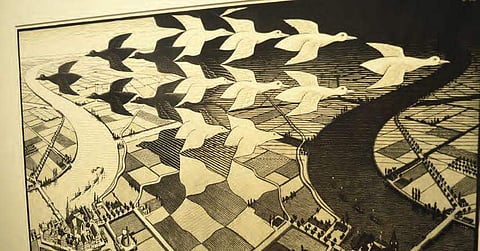
The Palace shows the famous ‘impossible’ performances such as ‘Day and Night”. It is a masterful demonstration of symmetrical opposites, resulting in an artistic puzzle that captivates the viewer. The left side of the painting shows a daytime setting within which a long, winding canal running through a small city is bright white, lit up by the daylight sky. The right side of the painting displays the exact opposite: a night scene of the same angle, wherein the canal and sky are black, including the miniature city. Beginning at the centre of the landscape, white birds from the daylight emerge into the fold of the night sky, while the dark birds of night flock to the daytime sky. It creates a bewildering pattern of black and white tiles in the centre of the image, a composition that delivers a unique positive-negative geometric aspect to “Day and Night”.
In the Room of Escher, you step into his magical world. You change the perspective of yourself: children seem larger than their parents. Very special is the room with Optical Art. You think you see movement while it is not there: optical art is, like Escher, a sight illusion. Whoever walks up the wide staircase sees Escher’s dreams come to life: winding stairs, tipping over spaces and pseudo-Romanic passageways form connections to other worlds.
In these woodcuts and lithographs, he effortlessly combines different perspectives from the school building into one ostensibly coherent space. But those who take the time to look closely see strange things happening in all these prints. Smooth transitions lead to bizarre possibilities. Because Escher combines slinks, it is not immediately noticeable that they are impossible constructions.
The palace itself is quite interesting. Queen Mother Emma used it as a winter palace, in the summer she stayed at Soestdijk. The building was their working palace with the royals Wilhelmina, Juliana and Beatrix. Queen Mother Emma changed the garden room into a ballroom, the light dome in the hall was given beautiful stained-glass windows and paintings were painted above the doors in various rooms. Her Majesty had even hot running water in her bathroom, very modern before the end of the nineteenth century! In 1991, the family sold the property to the municipality of The Hague on condition that only cultural activities would take place.
The chandeliers fascinated me as much as the artworks of Escher. No two chandeliers were alike. Each room had a different and unique light hanging, giving a total surprise on entering. I wanted to close the museum visit in style: in the former kitchen of Queen Emma, which is now MC Café, I had a festive high tea – something befitting a visit to the royal place.
How to reach:
Jet Air has direct flights to Amsterdam from Delhi, Mumbai and Bengaluru. Distance from Amsterdam to The Hague is just 52 kms: 41 minutes by train, 50 minutes by road.
Useful links:
www.jetairways.com
www.holland.com
(The author is a documentary filmmaker and travel writer; she blogs at vijayaprataptravelandbeyond.com)