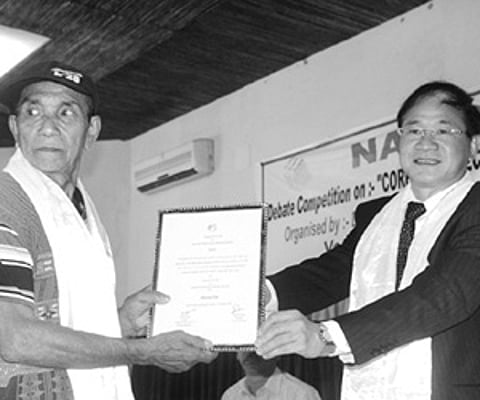

GUWAHATI: India’s war against China maybe history to us but to Alorno Pul, a Mishmi (tribe) of Walong sector in Arunachal Pradesh, it is as fresh as yesterday.
Alorno, a farmer called by many in Arunachal Pradesh a living legend, helped save both Indian lives and property on the 1962 warfront and rebuild the Walong sector. But sadly, the recognition came only on Tuesday, 48 years since the war.
During the height of the war, Alorno, like many other Mishmis, was employed by the Indian Army to carry their rations, guns and ammunition to hill-top Army camps and bunkers. He played his part but more importantly, played the ethnic card too to influence Chinese officers and soldiers. The man, now a septuagenarian, was honoured recently by the Arunachal Pradesh Government at Itanagar. The state’s PWD Minister Nabam Tuki handed him a ‘thank you’ certificate for his deeds in the war.' At the conclusion of the war, the Indian Army presented him with a ration card ensuring his lifelong access to subsidised defence canteens. But he lost it a few years ago. “Call it his humbleness that he is not seeking a replacement,” said S Mining, extra assistant commissioner (EAC), Hawai circle.
“At the dawn of the war, one day I discovered that the Chinese Army commander was also a Mishmi. I wasted no time and soon met him, rekindling the long-lost ethnic ties,” he said. A few days after this meeting, the Chinese Army one day called Alorno and other locals to Walong and asked them to take care of the abandoned villages and Indian Army camps. “Little did we realize that they were going back. “When it dawned on us that they indeed left, we got into the action carrying rations again - but this time to save villagers from starvation,” Alorno added.
