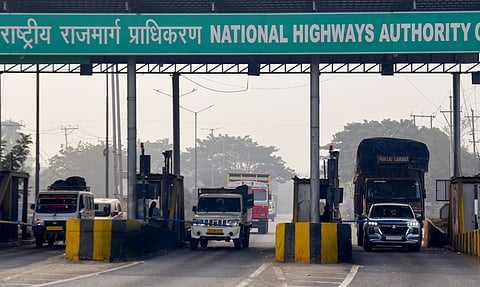

NEW DELHI: As the Centre prepares for a nationwide shift to barrier-less toll collection on national highways, the National Highways Authority of India (NHAI) is set to overhaul its central toll monitoring system to support the next generation of electronic tolling.
The Indian Highways Management Company Limited (IHMCL), the NHAI arm responsible for electronic toll collection, is upgrading its existing Toll Monitoring and Control Centre (TMCC) into TMCC 2.0, a centralised digital command platform that will oversee both the current FASTag-based tolling system and the upcoming Multi-Lane Free Flow (MLFF) tolling regime.
The move comes as the government accelerates the rollout of MLFF, which eliminates physical toll plazas and barriers, allowing vehicles to be charged while travelling at highway speeds through overhead gantries equipped with RFID readers and Automatic Number Plate Recognition (ANPR) cameras. MLFF is currently operational on a pilot basis at 17 locations across Gujarat, Haryana, Rajasthan, Delhi, Tamil Nadu, Maharashtra and Andhra Pradesh. In the first phase of expansion, the barrier-less system is proposed to be introduced at 105 locations across these states.
Officials said the upgraded platform will provide real-time monitoring of toll transactions, revenue collection, equipment performance, enforcement, financial reconciliation and service-level compliance across more than 1,200 toll plazas, while supporting the phased implementation of MLFF across the national highway network.
The existing TMCC, operational since 2021, functions as a central monitoring and analytics platform for electronic tolling. However, officials said the transition to barrier-less tolling requires a far more sophisticated technology backbone capable of handling high-volume, real-time data and automated enforcement.
A key feature of the upgraded command centre will be an automated financial reconciliation system aimed at plugging revenue leakages. The platform will compare toll transaction records generated at plazas with payment data received from acquiring banks and the National Payments Corporation of India (NPCI), flagging discrepancies in real time. For MLFF corridors, the system will also reconcile vehicle detection records, toll computation, payment settlement and enforcement data, creating an end-to-end audit trail for every journey.
Officials said that the TMCC 2.0 will also serve as a nationwide health-monitoring platform for tolling infrastructure. RFID readers, ANPR cameras, lane controllers, communication systems and MLFF gantry equipment will be monitored through a central dashboard, enabling authorities to detect faults and improve system uptime.
