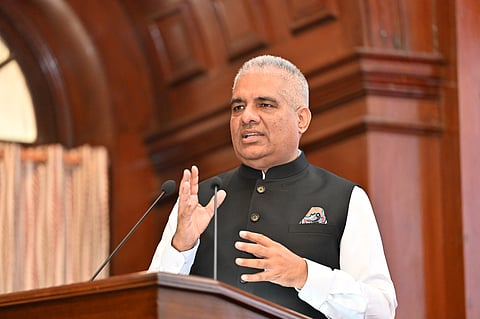

DEHRADUN: Young Indian Forest Service (IFS) officers must combine technological innovation with public participation and human sensitivity to tackle the growing challenges of climate change, biodiversity loss and desertification, Union Environment, Forest and Climate Change Minister Bhupender Yadav said on Saturday.
Addressing the convocation of the 2024 batch of IFS probationers at the Forest Research Institute here, Yadav said emerging technologies, including artificial intelligence, should move beyond merely collecting and analysing environmental data to providing practical, people centric solutions.
“The coming years will present major challenges such as climate change, biodiversity loss and desertification. Addressing them will require equal emphasis on innovation, modern technology and people’s participation,” the minister said.
He urged the young officers to ensure that technology was deployed with human sensitivity, particularly while working with forest dependent communities and managing the country’s natural resources.
Yadav, who presided over the ceremony, awarded certificates and medals to the probationers who successfully completed their training at the Indira Gandhi National Forest Academy (IGNFA).
After presenting the medals, the minister said the training at the premier institution had prepared the probationers for responsibilities beyond conventional forest administration.
He said the officers would be at the most productive stage of their careers when India marks the centenary of its Independence and would, therefore, play a significant role in shaping and leading the country’s Viksit Bharat 2047 vision.
“Ethics and efficiency are the strongest foundations of a successful public servant,” Yadav said. “High moral standards, judicious use of time and the ability to deliver maximum results with limited resources define the true identity of an officer,” he added.
Calling upon the probationers to aspire to be leaders rather than merely administrators, Yadav said sacrifice, compassion and the ability to inspire others were essential leadership qualities.
“Leadership is not merely about administration; it is about bringing positive transformation to society,” he said, adding that a good officer must first be a good human being.
He also advised the probationers to make self assessment and self awareness integral to their professional lives. Each officer’s journey after training would be different, he said, and continuous learning from field experience would be crucial.
Earlier, IGNFA Director Rajendra Prasad Khajuria said 111 officers — 109 IFS probationers and two officer trainees from Bhutan — had completed the academy’s 20 month training programme under a revised curriculum aligned with the Viksit Bharat 2047 vision.
Khajuria said the training covered forestry, wildlife management, environmental governance, advanced technology and leadership development.
Tracing the academy’s legacy to 1938, he said it had trained all IFS officers of independent India, besides 369 forest officers from 14 partner countries.
