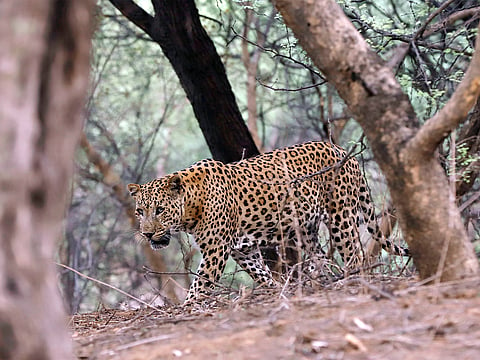

NEW DELHI: The Ministry of Environment, Forest and Climate Change has reaffirmed its commitment to conserving one of Asia's most elusive wild cats through the launch of the Clouded Leopard Conservation Action Plan (CAP).
The ministry released the dedicated Conservation Action Plan to mark International Clouded Leopard Day. The plan focuses on habitat protection, scientific monitoring, landscape connectivity, transboundary cooperation with neighbouring countries, and community participation across Northeast India.
The clouded leopard (Neofelis nebulosa) is a medium-sized wild cat native to the Himalayan foothills and Northeast India. It is currently listed as 'Vulnerable' on the IUCN Red List and is the state animal of Meghalaya.
The CAP was prepared under the Government of India–Global Environment Facility (GEF)–UNDP initiative and was released during the 91st meeting of the Standing Committee of the National Board for Wildlife (SCNBWL), held in Coimbatore in the second week of July 2026.
The action plan provides a comprehensive framework for securing habitats, restoring forest connectivity, strengthening scientific monitoring, and empowering local communities to support the conservation of the species.
It represents a significant step towards strengthening the long-term conservation of the clouded leopard across Northeast India. The strategy emphasises landscape-level conservation, scientific assessment, community participation, and technology-driven interventions to protect both the species and its habitats.
A key component of the plan is the identification of 14 priority conservation landscapes across Northeast India. It also includes habitat restoration and the conservation of wildlife corridors to improve connectivity between forest habitats.
The government has further strengthened the institutional framework for clouded leopard conservation by including the species under the Species Recovery Programme of the Integrated Development of Wildlife Habitats (IDWH) scheme.
The plan outlines standardised scientific monitoring methods, including camera trapping, occupancy surveys, genetic analysis and environmental DNA (eDNA) analysis, to improve understanding of the clouded leopard and its habitat requirements. It also emphasises stronger anti-poaching measures and wildlife crime prevention.
Recognising the vital role of local communities in wildlife conservation, the action plan promotes community-based conservation and supports sustainable livelihoods. It also encourages transboundary cooperation with neighbouring range countries to coordinate conservation efforts across the species' distribution. In addition, the CAP incorporates climate resilience and adaptive management into conservation planning to strengthen the long-term resilience of habitats and landscapes that support the clouded leopard.
