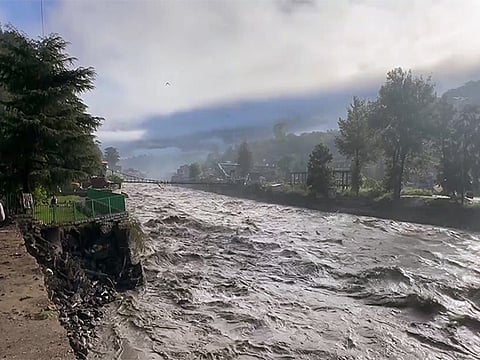

SRINAGAR: Cloudbursts have become an increasingly frequent weather phenomenon in Jammu and Kashmir, with the region witnessing 44 such incidents since the onset of the monsoon in July.
The cloudbursts have claimed 35 lives and caused widespread damage to public and private property, including houses, roads, bridges and agricultural land.
The latest cloudbursts were reported on Tuesday at Nandimarg in Kulgam district in south Kashmir and Boniyar in north Kashmir's Baramulla district.
The cloudbursts triggered flash floods, but there was no loss of life or injury.
"Two more cloudbursts struck yesterday. One of them was reported in Kulgam and another in Boniyar," Director of the Meteorological Centre, Kashmir, Dr Mukhtar Ahmad, told this newspaper.
On Monday, cloudbursts hit the Himli area of north Kashmir's Kupwara district, causing the death of a woman. Cloudbursts were also reported from Batkoot in Pahalgam in Anantnag district, Budherhama in Shopian district and Arin-Dardpora in Bandipora district.
According to Ahmad, 44 cloudbursts have struck Jammu and Kashmir since the onset of the monsoon this year.
The incidents have been reported from Shopian, Kupwara, Bandipora, Anantnag, Pahalgam, Budgam and Ganderbal districts in the Kashmir Valley, and Poonch, Rajouri, Kathua, Doda and Kishtwar districts in the Jammu region.
The cloudbursts have triggered flash floods, landslides and mudslides, claiming at least 35 lives and causing damage worth crores of rupees to public infrastructure, houses, roads, bridges and agricultural fields.
"The increasing frequency of such incidents is consistent with the broader impacts of climate change and global warming. In the context of Jammu and Kashmir, the monsoon in combination with Western Disturbances is triggering the cloudbursts," Mukhtar said.
He said tracking localised weather is extremely difficult, and there is no weather system or model anywhere in the world capable of predicting cloudbursts.
The weather system, he said, can predict rainfall, but the sudden changes in weather conditions that cause cloudbursts and flash floods cannot be predicted.
On July 19, a cloudburst hit Murrah-Bufliaz village in Surankote in the border district of Poonch, triggering flash floods and mudslides that buried a house with eight family members trapped inside. While the bodies of four victims have been recovered, four other family members are still missing.
According to Mukhtar, there is no technology anywhere in the world that can accurately predict a cloudburst or flash flood at a specific location.
On August 14 last year, a massive cloudburst struck Chesoti village in Kishtwar district, triggering flash floods and mudslides that claimed 100 lives. While the bodies of 68 victims were recovered, 32 people remain missing.
Climate experts say the Kashmir Himalayas are particularly prone to cloudbursts because "we have two weather systems. We get moisture from Western Disturbances and we get moisture from the southwest monsoon, which, in turn, draws moisture from the Bay of Bengal and the Arabian Sea".
"Moisture has the capacity to hold water in it. It is a heavy wind. It pushes up and rises quickly, touches the Himalayas and then forms a huge dense cloud. These clouds gather for a particular period and, when they become heavier, the atmosphere cannot bear their weight. The cloud then collapses, resulting in what we call a cloudburst," they said.
