
NEW DELHI: The government on Thursday approved the National Circular Bioenergy Scheme (GOBARdhan) with an outlay of Rs 23,731 crore to significantly scale up domestic Compressed Biogas (CBG) production over the next decade and also cleared an Rs 8,970.20 crore highway project for a four-lane access-controlled corridor between Guwahati and Tezpur in Assam.
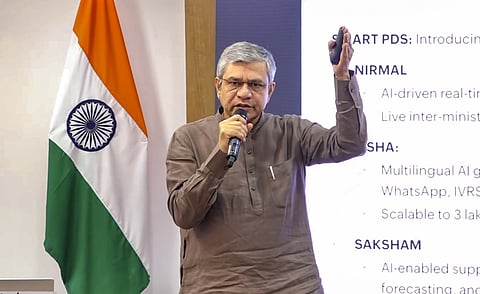
Speaking to reporters after the meeting of the Union Cabinet and the Cabinet Committee on Economic Affairs, chaired by Prime Minister Narendra Modi, Information & Broadcasting Minister Ashwini Vaishnaw said the GOBARdhan scheme will be implemented from financial year 2026-27 to 2035-36 with the objective of increasing domestic CBG production nearly ten-fold.
The scheme seeks to establish an integrated framework covering assured off take, stable pricing, capital support, pipeline connectivity, credit assistance and technology development to strengthen India's clean energy ecosystem, the Minister added.
Describing the initiative as a major step in India’s energy transition, Vaishnaw said the scheme would convert agricultural residue, cattle dung, press mud, municipal organic waste and other biomass into clean fuel, organic manure and additional income for farmers, while enhancing national energy security and promoting scientific waste management.
“The new programme builds on existing initiatives, including the Sustainable Alternative Towards Affordable Transportation (SATAT) scheme, the Market Development Assistance (MDA) Scheme, the Biomass Aggregation Machinery (BAM) Scheme, the Development of Pipeline Infrastructure (DPI) Scheme and financial support under the National Bioenergy Programme. These initiatives have already facilitated the commissioning of more than 200 CBG plants across the country,” the government said in a statement.
According to the government, GOBARdhan will integrate the entire CBG value chain on a single platform, improving project viability and providing greater certainty for investors and lenders.
A key feature of the scheme is the introduction of a guaranteed market for CBG. City Gas Distribution (CGD) entities will procure the fuel to meet the government's mandatory blending targets of 3 percent in financial year 2026-27, 4 percent in 2027-28 and 5 percent from 2028-29 onwards for the CNG (Transport) and PNG (Domestic) segments.
To ensure long-term revenue certainty, the government has fixed an administered price of Rs 2,110 per Metric Million British Thermal Unit (MMBTU) under a minimum 10-year pricing framework.
The scheme also provides capital assistance of up to Rs 2 crore per tonne per day (TPD) of installed capacity for eligible greenfield CBG projects. A dedicated credit guarantee mechanism will support MSME-based projects, while funding will be provided for pipeline connectivity to link CBG plants with gas networks. In addition, a CBG Ecosystem Challenge Fund will be created to strengthen district-level implementation and improve biomass feedstock supply chains.
The government said the scheme is expected to reduce dependence on imported fossil fuels, expand renewable gas production, create new livelihood opportunities for farmers and rural entrepreneurs.
In a separate decision, the CCEA approved the construction of a 135.871-km, four-lane access-controlled Guwahati-Tezpur Corridor on National Highway-15 in Assam at an estimated cost of Rs 8,970.20 crore.
Vaishnaw said the project will be developed under the Build-Operate-Transfer (BOT) Toll mode. The corridor is expected to improve connectivity in Assam, reduce travel time and ease congestion on the existing NH-27 East-West Corridor along the southern bank of the Brahmaputra.
The project also includes a 4.9-km Emergency Landing Facility on the Tezpur Bypass, planned in coordination with the Indian Air Force, and the construction of five major bypasses spanning 58.7 km. These bypasses will divert through traffic from densely populated towns, including Baihata Chariali, Sipajhar, Kharupetia, Dekiajuli and Tezpur, improving traffic flow and road safety in the region.
