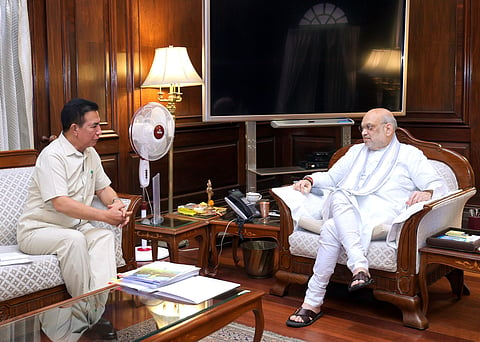

The contentious FCRA amendment bill will be taken up for discussion and passage in Parliament on August 12 but it will not come into effect retrospectively, Mizoram Chief Minister Lalduhoma said after meeting Union Home Minister Amit Shah.
Lalduhma and a delegation of church leaders from Mizoram conveyed their concerns to Shah over the Foreign Contribution (Regulation) Amendment Bill, 2026, which seeks to significantly tighten the oversight of foreign-funded organisations, proposing creation of a powerful new authority to seize and manage the assets of non-profits that lose their licence.
"We have conveyed our apprehensions on the new FCRA bill to the home minister. He assured us that the bill will not come into effect retrospectively," he told reporters at the Parliament House complex.
Asked whether the home minister indicated any date for discussion and passage of the FCRA amendment bill in Parliament, Lalduhma said Shah told him that the proposed legislation will be debated in the House on August 12.
The bill was introduced in Lok Sabha on March 25.
The bill provides for a comprehensive framework for vesting, supervision, management and disposal of foreign contributions and assets in a 'designated authority', including provisional and permanent vesting.
The foreign contribution and the assets created out of foreign contribution of any person--whose certificate has been cancelled under Section 14; or who has surrendered the certificate under section 14A; or whose certificate has ceased under section 14B or any rules made under this Act -- shall, from the date of such cancellation, surrender or cessation, vest provisionally in the Designated authority in such manner as may be prescribed, the proposed law said.
If an individual fails to obtain a fresh certificate or gets their certificate renewed or restored within the period referred in the law, the foreign contribution and the assets created out of foreign contributions shall thereupon stand permanently vested in the Designated authority, the Bill proposes.
In a memorandum submitted to Shah, Lalduhma, along with Mizoram Kohhran Hruaitu Committee (MKHC) chairman John Raldosanga and Council of Churches in Mizoram (CCM) general secretary Lalhmangaiha, said the bill and its rules should operate prospectively as retrospective application of regulatory provisions may create uncertainty and expose bona fide organisations to penalties for past procedural variations.
The MKHC and CCM represent major church denominations in Mizoram.
"Prospective application, accompanied by saving clauses and transitional safeguards, would ensure that national regulatory objectives are achieved without disrupting schools, healthcare units, and social safety nets that have been built over decades of dedicated service," the memorandum said.
Lalduhma and the church leaders said organisations which voluntarily choose to discontinue foreign funding or undergo restructuring should not be regarded as defaulting entities.
"Such decisions are, in fact, acts of compliance and transparency, reflecting a willingness to disengage from foreign contributions in good faith. Their assets, acquired legitimately and dedicated to public welfare, ought to remain protected so that they may continue serving their charitable purposes without interruption," they said.
The memorandum also said allowing continuity in the use of these assets would preserve vital community services such as schools, hospitals, orphanages, and rehabilitation centres, while also demonstrating the government's commitment to fairness, proportionality, and the encouragement of voluntary compliance.
"This approach would reassure civil society that lawful welfare initiatives are valued, and that the regulatory framework seeks to strengthen cooperation rather than penalise genuine organisations," it said.
The Catholic Bishops' Conference of India (CBCI) had earlier urged Shah to withdraw the FCRA bill and the notified rules, stressing that both be redrafted after wider consultation with stakeholders.
The CBCI had submitted a memorandum to Shah on July 10, raising concerns over the proposed bill.
(With inputs from PTI)
