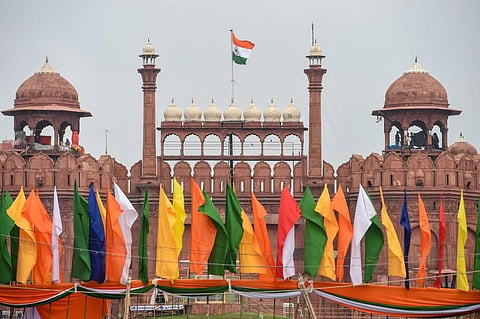

NEW DELHI: Vande Mataram will be played at the Red Fort on August 15, marking the first time the national song will feature as a scheduled item in the formal Independence Day programme, a defence ministry official said. It will be rendered immediately before the national anthem at the close of the Prime Minister’s address.
The addition comes just over a week after Parliament passed the Prevention of Insults to National Honour (Amendment) Bill, 2026, extending to Vande Mataram the protection the 1971 law affords the national anthem.
Introduced in the Rajya Sabha on July 24, the Bill makes intentionally preventing the singing of the national song or disturbing an assembly engaged in it punishable with imprisonment of up to three years, a fine, or both, with a minimum one-year jail term for a second conviction. The Bill now awaits presidential assent.
The full Red Fort programme is yet to be released. In recent years, the ceremony has concluded with NCC cadets singing Jana Gana Mana after the Prime Minister’s address, while patriotic songs have been performed earlier in the morning by an NCC choir before his arrival.
The government has already invoked an Independence Day precedent for the song.
Replying during the parliamentary debate, Minister of State for Home Nityanand Rai said that on August 15, 1947, Sardar Vallabhbhai Patel had asked Pandit Omkarnath Thakur to render the complete Vande Mataram on All India Radio at 6.30 am to mark the beginning of India’s first Independence Day. His reference to the complete rendition assumes significance because the government has not indicated whether the Red Fort ceremony will feature only the two stanzas in national use or a longer version.
That distinction lies at the centre of a political debate revived during the song’s 150th anniversary year. Launching the commemorations in November last year, Prime Minister Narendra Modi said significant portions of Vande Mataram had been removed in 1937, that the song “was torn apart”, and that the division “sowed the seeds of Partition”. The Congress rejected the charge, arguing that Rabindranath Tagore himself had advised retaining only the opening two stanzas and calling it unfair to attribute a divisive ideology to the Nobel laureate.
Meeting in Calcutta from October 26 to November 1, 1937, under Jawaharlal Nehru’s presidentship, the Congress Working Committee adopted an October 1937 resolution retaining only the opening two stanzas for national use, thereby excluding the later verses invoking Hindu deities including Durga and Lakshmi.
In a letter to Nehru dated October 26, 1937, Tagore wrote that while the complete poem, read in context, could offend Muslim sentiment, the opening two stanzas by themselves need not. The CWC separately appointed a committee comprising Nehru, Subhas Chandra Bose, Maulana Abul Kalam Azad and Acharya Narendra Dev to identify other patriotic songs in simple Hindustani.
The controversy also reached Parliament earlier this year. Union Home Minister Amit Shah told the Rajya Sabha that the truncation marked the beginning of a politics of appeasement that ultimately led to Partition. Congress MP Jairam Ramesh responded that Rajendra Prasad had written to Vallabhbhai Patel in September 1937 urging the Congress Working Committee to take a considered position, asking whether Shah was accusing Prasad and Patel too of appeasement.
The Supreme Court’s 1986 judgment in the Bijoe Emmanuel case held that no person can be compelled to sing either the national anthem or the national song and that standing respectfully in silence does not amount to disrespect.
