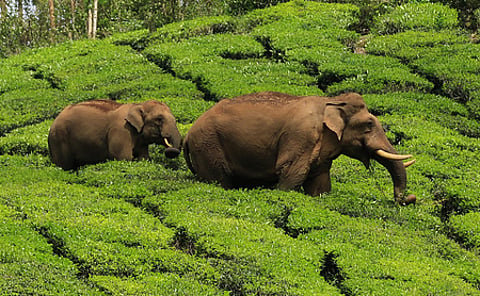

NEW DELHI: The Ministry of Environment, Forest and Climate Change (MoEFCC) has recommended the use of herbicides and other chemical control methods to manage invasive plant species in elephant habitats as part of measures to reduce human-elephant conflict.
The ministry said invasive plants had suppressed natural food sources for elephants, forcing them to raid crops in villages located along forest edges. It recommended that chemical control methods be used judiciously and in an environmentally safe manner without harming non-target species.
The recommendations are part of the “Regional Action Plan for Comprehensive Understanding and Management of Human-Elephant Conflict,” released during the 23rd Steering Committee Meeting of Project Elephant, chaired by Kirti Vardhan Singh in Visakhapatnam.
The action plan focuses on ecological assessments, habitat and corridor management, landscape-level planning, spatial risk assessment, community participation, institutional strengthening, technological innovation and adaptive management.
The report also recommends biological control agents, such as insects, to manage invasive plants, but only after thorough risk assessments. Mechanical methods, including manual removal and cutting of invasive plants, have also been suggested.
The report proposes dividing elephant landscapes into different zones based on conflict intensity and land-use patterns to enable site-specific interventions. These include Elephant Conservation Zones in core forest areas, Human-Elephant Co-existence Zones at the forest-settlement interface and Human-Elephant Management Zones in human-dominated areas.
The Elephant Conservation Zones will focus on habitat restoration, fodder enrichment, water augmentation and regulation of human activities. The Human-Elephant Management Zones will address chronic conflict through measures such as translocation or rehabilitation of problematic elephants.
The action plan takes a landscape-level approach to managing human-elephant conflict while focusing on habitat improvement, conflict-risk assessment and community participation.
On February 19, 2025, the MoEFCC constituted a sub-committee to prepare the regional action plan for comprehensive understanding and management of human-elephant conflict in South India. The committee was led by Sanjay K Srivastava, former Principal Chief Conservator of Forests (Apex), Tamil Nadu.
