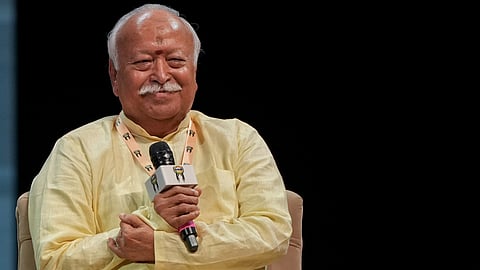

CHANDIGARH: Ahead of RSS chief Mohan Bhagwat’s US visit for the ‘Universal Oneness Celebrations’ organised by the American Hindus for Engagement and Dialogue (AHEAD) in New York on August 29, the United States advisory body on religious freedom, US Commission on International Religious Freedom (USCIRF) has called for sanctions against the RSS and urged the Trump administration to deny its leaders diplomatic courtesies or high-level meetings.
The USCIRF chair, Asif Mahmood, said Prime Minister Narendra Modi is a member of the RSS, which he described as an umbrella organisation whose sub-groups have perpetrated attacks on religious minorities. Also, USCIRF Commissioner Gene Mills stated that RSS leaders, even when affiliated with the Indian government, should not be honoured with high-level meetings or diplomatic courtesies.
In a series of posts on the X account, USCIRF posted the remarks by Mahmood and Mills. “Chair @DrMahmood40: ‘India’s PM Modi is a member of the Rashtriya Swayamsevak Sangh (RSS), an Indian umbrella organisation whose sub-groups have perpetrated attacks on religious minorities, incl. Christians & Muslims. Now the RSS leader, Mohan Bhagwat, plans to visit the U.S.’”
In another post, USCIRF wrote, “Cmmr @Gene_Mills: ‘RSS leaders, even when affiliated with the Indian gov’t, should not be honored with high-level meetings or diplomatic courtesies. Instead, the USG should focus on imposing sanctions on RSS members found responsible for FoRB violations.’”
The tour of Bhagwat is expected to cover the US, Canada and the UK from August 25 as part of the RSS’s centenary-year international outreach and is at the invitation of various local associations and organisations associated with the Indian diaspora.
The latest criticism follows the commission’s 2026 annual report in March that criticised India for alleged violations of religious freedom and recommended that the US designate India as a “Country of Particular Concern” over alleged religious-freedom violations. The report also recommended targeted sanctions against entities including the RSS and Research and Analysis Wing (RAW), such as asset freezes and entry restrictions.
While rejecting the USCIRF report, in March this year, the Ministry of External Affairs termed the commission’s “biased” characterisation of India and questioned its credibility, adding that the organisation has persistently presented a “distorted and selective” picture of the country that relies on questionable sources and ideological narratives. India also urged the commission to examine alleged attacks and vandalism targeting Hindu temples and members of the Indian diaspora in the US.
In a statement on March 16 this year, External Affairs Ministry spokesperson Randhir Jaiswal had said that instead of persisting with “selective criticism” of India, the USCIRF should reflect on “disturbing incidents of vandalism and attacks on Hindu temples in the US, selective targeting of India, and growing intolerance and intimidation of members of the Indian diaspora in the US, which merit serious attention”.
