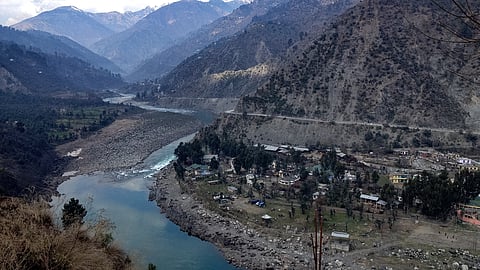

CHANDIGARH: After the Nepal disaster, apprehensions have grown among locals in Lahaul, Kullu-Manali and Mandi over multiple mega projects proposed in the region, including the Rs 2,356 crore Chenab-Beas River Link Project, the proposed 20,000 MW solar power transmission line and the Bhanupalli-Bilaspur-Manali-Leh broad gauge railway line.
Public representatives and residents are warning that these projects could have serious environmental, geological and socio-economic consequences in an already fragile Himalayan region. They are calling for fresh safety assessments and a comprehensive review of the environmental implications.
The Chenab-Beas River Link Project envisages diverting water from the Chandra River into the Beas through an approximately 8.7-km tunnel beneath the Pir Panjal range in Lahaul and Spiti district of Himachal Pradesh. The project has gained significance after the Indus Waters Treaty (IWT) was put in abeyance following the Pahalgam terror attack.
Public representatives are now warning that diverting water into the Beas basin could heighten flood risks and have environmental, geological and socio-economic consequences in the region.
Questions are also being raised about the proposed Rs 21,000 crore, 20,000 MW solar power transmission line from the cold desert plateaus of Pang and Nyoma in Ladakh to the national grid at Kaithal in Haryana, around 1,000 km away. Massive towers will have to be built, requiring enormous land parcels in an already constrained geography.
Amid mounting concerns over floods, extreme weather events, landslides and the vulnerability of Himalayan terrain, residents are demanding a comprehensive safety and environmental review of the project, which is reportedly aimed at generating around 4,000 MW of electricity, before any construction begins.
Locals are also raising concerns over the disposal of excavation debris during construction. They fear that improper dumping could obstruct river channels, increase downstream sediment loads and aggravate the impact of cloudbursts or glacial lake outburst floods by creating unstable debris dams capable of triggering flash floods.
In Phase I of the Chenab-Beas River Link Project, a 19-metre-high barrage is proposed to be constructed on the Chandra River near Koksar village in the Lahaul Valley. The topography around the proposed barrage site is rugged, and the river flows through a wide U-shaped valley. The diversion site is located near the village and upstream of the north portal of the Atal Tunnel at Rohtang.
Phase II of the proposal could involve power generation infrastructure linked to the diverted water flow.
Locals are also questioning the project’s proximity to the strategically important Atal Tunnel, expressing apprehension that extensive tunnelling and blasting could affect its long-term structural stability.
The Chenab is one of the six rivers of the Indus River System, which consists of the western rivers, Indus, Jhelum and Chenab, and the eastern rivers, Ravi, Beas and Sutlej.
Pointing out that the Beas River has caused extensive destruction in recent years during heavy monsoons, Kargil War hero Brig Khushal Thakur (Retd), speaking to this newspaper, said the disaster in Nepal had heightened anxiety among people living along the Beas basin.
Residents of Lahaul, Kullu-Manali and Mandi districts are now apprehensive about the proposed projects coming up in the region, which could prove disastrous for them, as it is an ecologically fragile area, he said.
Stressing that the entire issue needs to be examined holistically, Thakur said all the projects, the Chenab-Beas River Link Project, the 20,000 MW solar power transmission line and the proposed Bhanupalli-Bilaspur-Manali-Leh broad gauge railway line, should be reviewed.
“No one is against development. Keeping public safety in mind, both the state and Union governments should rethink the tunnel project before its execution,” he said.
He added that the Beas alone has always played havoc along its banks in Kullu-Manali and Mandi, resulting in damage to residential and commercial properties, besides agricultural and horticultural land.
Thakur added that locals would not benefit from any of these projects and that claims about checks and balances being put in place to avoid disasters would not be enough to save the region.
He also raised concerns over the massive Rs 21,000 crore power transmission project, which involves the evacuation of around 20,000 MW of solar power from the cold desert plateaus of Pang and Nyoma in Ladakh to the national grid at Kaithal in Haryana, around 1,000 km away.
There are also concerns over the proposed Bhanupalli-Bilaspur-Manali-Leh broad gauge railway line, with an estimated cost of over Rs 1,31,000 crore. It is one of the most strategic rail projects in the country.
Approximately 2,200 hectares of land would be acquired for the railway line at an estimated cost of Rs 11,500 crore, while approximately Rs 62,000 crore would be spent on the construction of bridges and tunnels. Around 55% of the entire route will be covered by tunnels. Large emergency escape tunnels are also reportedly part of the project to ensure passenger safety.
The final survey of the project has started.
Teams from a private company are marking the alignment of the proposed railway line from Salapad in Mandi to Sarchu. The land acquisition process is expected to begin soon after the land to be procured is identified.
“The proposed transmission line will cut through the already overburdened Manali-Kullu-Mandi-Bilaspur-Chandigarh corridor, which already has the four-lane Kiratpur-Manali highway that gets blocked many times due to frequent landslides, and not to forget the proposed Bhanupalli-Bilaspur-Manali-Leh broad gauge railway line,” Thakur said.
Advocate Sudarshan Thakur, a member of the people’s movement against the 400 MW Seli hydro project, said, “When we were studying in Chandigarh in the 1980s and 1990s and travelling back home to Kullu and Lahaul, we were never scared that stones would fall on the road.
“Now, after Bilaspur, one is scared to travel on the four-lane Kiratpur-Manali highway, as one does not know when landslides will come or when they will encounter shooting stones.
“In Mayar Valley in Lahaul, there is a village called Karpat. The entire population of 350 people was living in tents after flash floods hit. It was totally cut off from the rest of the state as bridges were washed away, and 50% of their agricultural land was washed away.
“The reason is simple: dams are being constructed and the natural water flow is being stopped. What happened in Nepal is expected to take place in Lahaul when many projects come up in this Himalayan region.”
Guman Singh, an environmentalist and coordinator of Himalaya Niti Abhiyan, said, “We oppose all these proposed mega projects as they will totally finish this fragile Himalayan region and also affect tourism in Manali. Also, due to global warming, these projects will affect horticultural production, glaciers will melt faster, and more flash floods and landslides are in the offing.”
