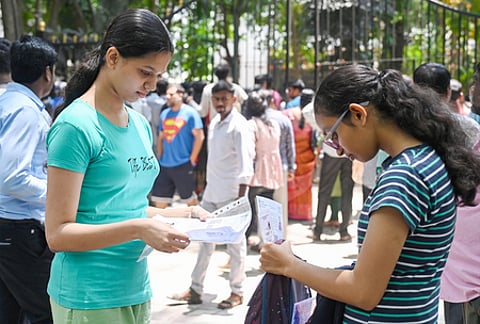

NEW DELHI: Over 2.73 lakh medical graduates will appear for NEET-PG 2026 on Sunday, with the examination scheduled across 1,300 centres in 340 cities, even as authorities said they have put in place a robust multi-layered security setup to smoothly conduct the medical entrance test.
The National Board of Examinations in Medical Sciences (NBEMS) has registered a total of 2,73,183 candidates for this year’s examination, an increase of more than 12.5 percent over the previous year.
The test will be conducted in a single shift from 9 am to 12:30 pm through a Computer Based Examination (CBT) mode.
The National Eligibility cum Entrance Test for Postgraduate (NEET PG) 2026 examination will determine eligibility for admission to advanced medical courses, including MD (Doctor of Medicine) and MS (Master of Surgery), offered by government and private medical colleges.
Union Health and Family Welfare Minister JP Nadda had recently reviewed preparations for the examination and directed the authorities involved to ensure a secure, transparent, technology-enabled and candidate-friendly process.
Among the various reforms, authorities had also announced that this time aspirants will get three choices for their test locations, which will be confirmed to them nearly three weeks before the exams. However, due to technical glitch candidates received wrong city intimation centres, some as far off as 2,000 km away. The error was corrected soon after.
Though, it was promised that the admit card will be issued early. But after four failed attempts, the NBEMS was able to finally issue the admit cards on August 26.
Elaborate security arrangements, including CCTV surveillance, biometric authentication, frisking, signal jammers, dynamic computer allocation and live monitoring through central and regional command centres, have been announced.
More than 60,000 examination personnel have been deployed as part of the arrangements.
The final question paper will be selected through a secure, encrypted and time-bound process shortly before the examination begins, with technological and operational safeguards intended to protect its confidentiality until the scheduled start.
The examination pattern has been revised to 180 questions to be answered in 210 minutes, giving candidates more time per question.
Aadhaar-based authentication has been incorporated at both registration and examination stages, while iris-based biometric verification will provide a backup where fingerprint authentication fails.
To further strengthen transparency and curb unfair practices, the NBEMS, which conducts the specialised and post-doctoral exams, has operationalised a dedicated email address for reporting instances of impersonation, touting and other unfair means, while issuing regular advisories to candidates to promote awareness and vigilance.
