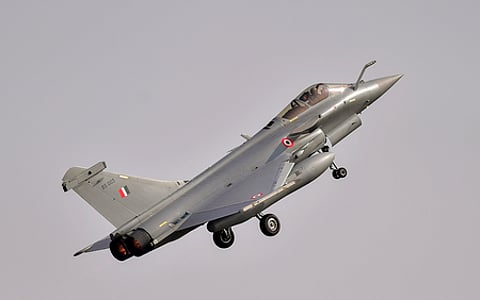

NEW DELHI: Faced with a spares crunch for a fleet that is largely of foreign origin, the Indian Air Force (IAF) is leaning on in-house 3D printers, digital twin technology and a network of 930 Indian firms to keep its jets flying.
The push has yielded around 62,300 indigenised aircraft spares so far, saving the exchequer Rs 582 crore in foreign exchange over the last five years and cutting the force's reliance on foreign original equipment manufacturers (OEM), it is learnt.
Those locally made items now cover 97 percent of the spares that operational units draw most frequently, and 93 percent of the mandatory spares required for the overhaul of decentralised fleets, sources in the defence establishment said.
The crunch is not only a consequence of the war in Ukraine. A large part of the IAF's inventory is of Soviet and Russian vintage and for several of these legacy platforms the original production lines shut down years ago. Spares for them are no longer manufactured anywhere, leaving the force to either extend the service life of what it has or make the part itself.
That is why indigenisation, as the IAF defines it, stretches well beyond fresh manufacture. It covers repair, refurbishment, reclamation, upgradation, modification, replacement and life revision of aircraft and systems, with life revision studies used to safely extend the life of components that cannot be bought off any shelf. The war in Ukraine sharpened the problem further by squeezing supply lines for aircraft still in production.
The 930 Indian firms now working with the IAF on its maintenance requirements bring competencies in mechanical, electrical, electronics and rubber manufacturing, and range from established private players to MSMEs machining a single component.
Central to this tech push is a 3D additive manufacturing facility, set up in-house in 2022 to shorten turnaround times and reduce dependency on external supply chains. It fabricates urgent, low-volume parts in certain aluminium, steel and titanium alloys, covering non-critical airborne spares and ground equipment components.
"The facility is uniquely positioned as an internal resource for low volume, urgent and on-demand requirements," sources in the IAF said. "The existing setup is fully equipped to take on demand-based requirements depending on the build volume of the spare."
The force is simultaneously moving from reactive repair to prognostic-based maintenance built on digital twin technology. AI and predictive analytics allow technical crews to monitor the health of a system in service and flag a hardware fault before it causes an operational failure, sources said.
Underpinning both is a digitised maintenance backbone. The IAF's Electronic Maintenance Management System, or e-MMS, went live on 1 December 2020 and was dedicated to the nation by Defence Minister Rajnath Singh at Aero India in February 2023. Repeatedly upgraded since, it now runs record-keeping, inventory and overhaul tracking across the force, and supports operational preparedness and maintenance safety, sources said.
"Considering the overall magnitude, spread and complexity, e-MMS is one of the largest enterprise asset management applications in the maintenance, repair and overhaul field anywhere in the world," sources said, describing it as an outcome of public-private partnership under the Digital India push.
The scale of the opportunity for industry is considerable. The Directorate of Aerospace Design is monitoring around 180 innovation projects with Indian companies, including MSMEs and start-ups, under the Make, iDEX and Technology Development Fund schemes. These have generated business worth more than Rs 17,000 crore for the domestic defence manufacturing ecosystem, sources said.
Sources explained that the domestic share of the IAF's capital budget expenditure has stood at roughly 90 percent over the last two financial years, above the guideline mandated by the defence ministry.
The drive spans the Su-30MKI, Rafale, Tejas, Mirage 2000, MiG-29 and Jaguar fleets, and recent tenders show how granular the requirements have become. One Su-30MKI tender listed fuel pumps, drogue assemblies, control panels, valves, hoses and torque drum units. Others cover spares for the Mirage 2000 and printed circuit board assemblies for radars.
The Sankalp-2026 compendium, released earlier this year, sets out further problem statements for industry on Russian-origin platforms. A "plant-in-plant" model, under which private technicians work inside secure base repair depot premises, is also being examined. The IAF has separately built research partnerships with the IITs, the Indian Institute of Science, the Defence Institute of Advanced Technology and the Military Institute of Technology, and set up nodal technology centres at its base repair depots.
The force's combat fleet currently stands at 29 fighter squadrons against a sanctioned strength of 42.5, which makes serviceability of the jets it already has a more immediate concern than ever.
