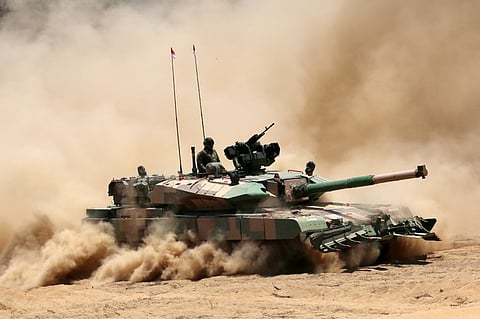

NEW DELHI: Six years after the first of its Arjun tanks became due for overhaul, the Army has finally begun the process of rebuilding them, with two Arjun Mk-1s set to be stripped down and refurbished at the Heavy Vehicles Factory in Avadi near Chennai.
The two tanks will also be fitted with 26 upgrades drawn from the newer Arjun Mk-1A, sources in the defence establishment said.
"The two tanks are part of a pilot programme. The repair procedures and assembly process sheets developed during their rebuilding will form the basis for the overhaul of the remaining tanks in the Army's 124-strong fleet," a source said.
The Arjun has not undergone an overhaul so far. A CAG performance audit in 2016 had said that the tank, inducted from 2004, was due for its first overhaul from 2020, but that the agency responsible for carrying it out was yet to be identified.
The same audit found the Arjun had not been operational since 2013 because of the absence of repair and overhaul facilities and inadequate spares support, with HVF unable to supply what was needed.
Nonetheless, engine-level work had been going on in the interim. Engine Factory Avadi and CVRDE had already run an overhaul exercise on the Arjun powerpack and the scope of work for the present project draws on it. What had not happened until now was a full tank overhaul, in which the hull and turret are stripped and rebuilt.
Moreover, much of the technical documentation required for the job still does not exist. Repair procedures will have to be worked out on the basis of the condition of individual components as the tanks come apart on the shop floor.
Of the 26 improvements to be retrofitted, six are major upgrades. These include a commander's panoramic sight, the Mk-II gunner's main sight, an automatic target tracker, an improved muzzle reference system, a new track with increased horn height and an advanced running gear system.
The 20 smaller ones range from a compact high-power auxiliary power unit and an improved fire detection and suppression system to LED headlamps, better sealing against dust and heating elements in the periscopes.
"Once the tanks are dismantled, the various assemblies will be sent to the respective specialists for repair and overhaul. The engine will go to Engine Factory Avadi, the transmission and final drive to RENK's Indian arm, the 120mm gun and cradle to Advanced Weapons and Equipment India, and the gun control system to Bosch Rexroth in Germany," the source said.
Several components, including the gyros for the gun control system, batteries, tracks, the panoramic sight and the fire detection system, are to be sourced from Indian companies.
Keeping the fleet running has been difficult from the outset, largely because so much of the tank came from abroad. A separate CAG report in 2017 put the imported content of the Mk-1 at 69% at the time of induction, with suppliers spread across Germany, Belgium, France, Israel and the UK, several of whom have since wound up or moved on.
That report also held that the failure of DRDO's Combat Vehicles Research and Development Establishment to indigenise the required components and of HVF to provide spares, had hurt the tank's availability.
The Arjun is powered by a 1,400 hp MTU engine from Germany coupled to a RENK transmission. The powerpack is rated for 600 hours of running or 5,000 km before its first overhaul falls due.
The tank's bulk has been a problem of its own. Moving it requires either dedicated broad-gauge rolling stock or specially configured road transporters, both expensive and in short supply. The 2017 audit calculated that shifting a single regiment of about 60 Arjuns needed 16 extra three-tonne vehicles and at least 50 additional personnel.
Once rebuilt, the two tanks will undergo hull and turret stand tests, stability proof and running trials, followed by limited validation trials at the Pokhran field firing range. The overhaul carries a warranty of 24 months or 150 engine hours, whichever is earlier.
Meanwhile, the 118 Arjun Mk-1A tanks ordered from HVF in September 2021 for Rs 7,523 crore are yet to be delivered, with engine supply the main bottleneck.
The existing fleet of 124 Mk-1s, inducted between 2004 and 2010, equips two armoured regiments, 43 and 75 Armoured, deployed in the Rajasthan desert.
