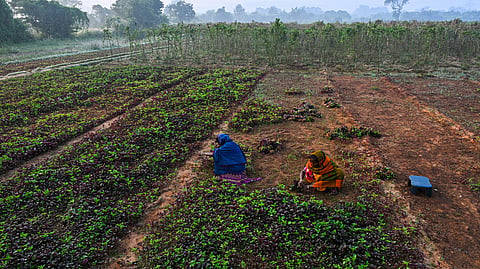

RAIPUR: Despite the official onset of the monsoon in Chhattisgarh, a slowdown in rainfall seems to have drastically hit agricultural activities across the state.
Sowing for major Kharif crops, including paddy (rice), has been disrupted.
Against the targeted goals, paddy sowing has reached only 12 per cent, while overall Kharif sowing stands at a dismal 10.6 per cent. In stark contrast, by this time last year, paddy sowing had crossed 37 per cent and overall Kharif sowing was at 33 per cent.
Fearing a delayed monsoon, patchy rainfall or any dry spells during the 2026 Kharif season due to the potential impact of Al-Niño, the Chhattisgarh government has formulated a general contingency plan for the state's farmers.
Prepared under the leadership of Chief Minister Vishnu Deo Sai and the guidance of Agriculture Minister Ramvichar Netam, the action plan aims to secure crops, maintain production levels, and reduce cultivation costs even in low-rainfall scenarios.
The Department of Agriculture has strongly advised farmers to opt for short-to-medium-duration crop varieties to mitigate the impact of weather uncertainties.
In particular, the government has urged a shift from traditional transplanting methods to the Direct Seeding of Rice (DSR) technique.
According to officials, the benefits of DSR include saving up to 20 per cent of water, cutting input costs by approximately Rs 5,000 per acre and accelerating crop maturity, making it ready 12 to 15 days earlier.
Agricultural scientists warn that the delay in Kharif sowing could impact ultimate crop yields. To conserve moisture, farmers are encouraged to clean fields, plow timely, and build field bunds before the arrival of rains.
To mitigate potential losses and cope with drought-like conditions, the Department of Agriculture is urging farmers to focus on short-duration crops, pulses, and oilseeds instead of water-intensive paddy.
The government emphasised line-sowing methods to aid weed control, moisture retention, and better root development, keeping crops safer during dry spells. Mandatory seed treatment has been advised before sowing.
"Under low-rainfall conditions, efficient nutrient management is vital," the agriculture minister said.
Additionally, local communities are suggested to construct temporary check dams on village streams using sand-filled cement bags, harvest rainwater in farm ponds (dabris), community ponds, and wells, and reserve the water for critical life-saving irrigation.
