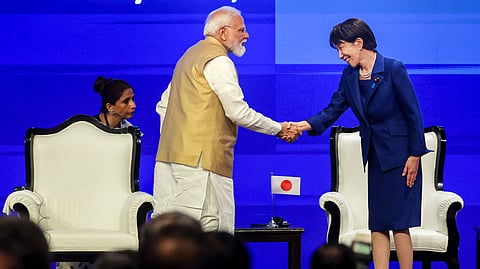

NEW DELHI: India and Japan on Thursday elevated their global strategic partnership with a twin push on defence manufacturing and economic integration, signing their first-ever defence co-development project while agreeing to upgrade the Comprehensive Economic Partnership Agreement (CEPA), as Prime Minister Narendra Modi described “unbreakable mutual trust” as the bedrock of bilateral ties.
The two sides also unveiled a roadmap on economic security, supply chain resilience, clean energy and biotech following the 16th India-Japan Annual Summit between Prime Minister Modi and his Japanese counterpart Sanae Takaichi.
“Today, we have signed an agreement on the first co-development project between India and Japan in the defence sector. This project for a naval radio antenna will open a new chapter in our defence technology partnership,” Modi said.
The pact relates to the Unified Complex Radio Antenna (UNICORN) project, a next-generation naval communications system designed to provide secure and reliable communications for warships.
The joint statement said both PMs welcomed the conclusion in principle of the remaining technical issues on UNICORN and agreed to explore additional defence equipment and technology collaborations. Modi welcomed Japan’s review of its principles governing the transfer of defence equipment and technology, which New Delhi sees as opening new avenues for industrial collaboration.
Both leaders also agreed to modernise the India-Japan Comprehensive Economic Partnership Agreement (CEPA), which came into force in 2011 but has come under scrutiny over its limited benefits for Indian exporters.
“Upgradation of the CEPA pact and review of its provisions were discussed....whether the agreement has become outdated in light of newer trade arrangements,” Foreign Secretary Vikram Misri said.
Sources said India has sought a review of several non-tariff barriers, particularly Japan’s stringent sanitary and phytosanitary (SPS) standards, which have constrained Indian exports despite preferential tariff access. “The global trade landscape has evolved considerably since 2011, and India has conveyed its interest in reviewing aspects of CEPA,” a senior government source said.
The summit also produced a Joint Roadmap on Economic Security, under which the two countries will strengthen supply chain resilience in strategic sectors including semiconductors, quantum technologies and advanced materials.
