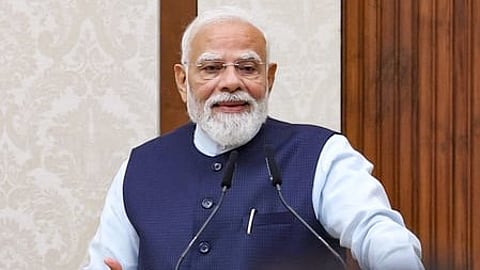

NEW DELHI: Prime Minister Narendra Modi's visit to Indonesia, Australia and New Zealand from July 8 to 11 is expected to advance India's strategic and economic interests across the Indo-Pacific, with cooperation on critical minerals, resilient supply chains, trade and defence taking centre stage.
The visit will also address emerging mobility issues, including delays in Australian student visas for Indian applicants, reflecting the expanding scope of India's partnerships in the region.
The three-nation tour comes as New Delhi deepens engagement with key Indo-Pacific partners amid shifting geopolitical alignments, intensifying competition over critical mineral resources and efforts to diversify supply chains away from excessive dependence on a few markets.
Indonesia, Australia and New Zealand together represent three distinct but interconnected pillars of India's Indo-Pacific strategy—maritime security, resource security and economic integration. The visit is also expected to reinforce India's Act East Policy and its vision of a free, open and rules-based Indo-Pacific.
Indonesia will be the first stop on the Prime Minister's tour. It will be Modi's fourth visit to the country and his first bilateral visit since India and Indonesia elevated ties to a Comprehensive Strategic Partnership in 2018.
As India's largest trading partner in ASEAN, Indonesia has emerged as an increasingly important economic and strategic partner. Besides supplying coal and palm oil, it possesses some of the world's largest nickel reserves, a critical mineral for electric vehicle batteries and clean energy technologies.
Indonesia's location astride the Malacca Strait, one of the world's busiest sea lanes, also makes maritime cooperation a key pillar of bilateral engagement.
Briefing reporters, Secretary (East) in the Ministry of External Affairs (MEA), Rudrendra Tandon said the visit reflects India's growing focus on the eastern maritime region.
"The focus has shifted to the eastern maritime zones of the Indian Ocean and our Act East engagement," he said.
From Indonesia, Modi will travel to Melbourne for the third India-Australia Annual Summit with Prime Minister Anthony Albanese.
Beyond defence and maritime cooperation, discussions are expected to focus on critical minerals, cybersecurity, emerging technologies, clean energy and supply-chain resilience—areas that have rapidly gained prominence in the bilateral relationship.
"The conversations will cover emerging areas of our bilateral relations, in particular critical minerals, the cybersecurity domain, supply-chain resilience, emerging technologies and so on," Tandon said.
Australia has become a vital partner in India's efforts to secure supplies of lithium, cobalt and rare earth minerals required for electric vehicles, renewable energy and semiconductor manufacturing.
The Prime Minister will also participate in the India-Australia CEOs Forum, where business leaders are expected to explore investment opportunities across manufacturing, technology and clean energy.
Responding to a question on visa restrictions, MEA Joint Secretary (Indo-Pacific) Vishwesh Negi said the issue would form part of the leaders' discussions.
"Australia remains a very popular destination for Indian students. We continue to remain engaged with the Australian government to ensure that the visa process for Indian students does not reduce opportunities for genuine students and professionals to move from India to pursue their interests in Australia. We are engaged with Australia on this issue, and it will be part of the discussion between the leaders," Negi said.
The inclusion of student mobility in summit discussions underscores how people-to-people ties have become an important dimension of the India-Australia partnership, complementing strategic cooperation under the Quad and expanding economic engagement.
India is also expected to reiterate its concerns over terrorism and violent extremism during bilateral discussions.
The final leg of the visit will take Modi to Auckland, marking the first visit by an Indian Prime Minister to New Zealand in nearly 40 years.
The visit follows the conclusion of a landmark free trade agreement that will eliminate tariffs on 95 per cent of New Zealand's exports, opening new opportunities in agriculture, food processing, dairy technology, education and investment.
New Zealand Prime Minister Christopher Luxon described the visit as historic.
