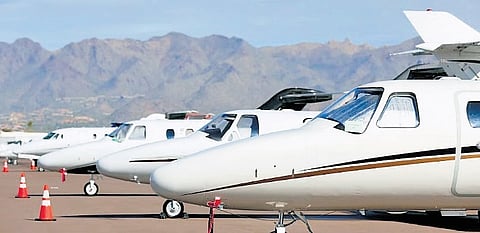

NEW DELHI: Private jet operators across the country have requested the aviation regulator, the Directorate General of Civil Aviation (DGCA), to put in place flying hours for the cockpit crew in line with global standards.
The DGCA recently undertook a review meeting with the operators. The Business Aircraft Operators Association (BAOA), which has 115 private and non-scheduled operators as its members, took part in the meeting. “A review meeting was held with the BAOA in which they requested for separate Flight Duty Time Limitation (FDTL) for their crew who fly their aircraft,” a DGCA source told this newspaper.
For private jet crew operators, a maximum of 8 hours of total flying time is permitted per day, as per the DGCA’s rules. A minimum of 10 consecutive hours of rest is mandatory within a 24-hour period while a maximum of two consecutive night duties and two night landings per week are permitted.
Extension of Diversion Time Operations (a set of regulations which decide how far passenger aircraft can fly from an alternate aircraft) for flights to 120 minutes from the existing 90 minutes too was discussed, it is learnt. Group Captain R K Bali (retd), Managing Director of BAOA, said, “India’s economic boom has ensured that we are among the fastest in the world when it comes to business aviation. We have around 500 such aircraft and the scope is huge in this sector. High Networth Individuals (HNI) in particular are keen on using them. Hence, we have asked DGCA for a rationalisation of FDTL norms and align them with international standards. We are very keen this is being implemented with priority given to adequate safety norms.”
Long-range aircraft, which would be deployed by corporate houses, to fly from Delhi or Mumbai to a city abroad will require a different operational schedule for pilots. “Hence, we requested for the rationalisation,” he said.
A committee has been constituted by the regulator to examine the proposal mooted by private operators. “We have met with the members of the committee and spelt out our requirements,” Bali added.
A top aviation official said there is enormous potential for helicopters and other private aircraft in the country. “Money is not a problem anymore in India which was the case in the past. However, what really ails this sector is the acute shortage of trained pilots. Most of the helicopters in the country are today operated by former or retired personnel from the defence sector. The need to train pilots on the smaller aircraft need to be undertaken on a war footing by the government to take advantage of the enormous potential this sector offers,” he said. The country would require up to 3,000 helicopters in future, the official added.
