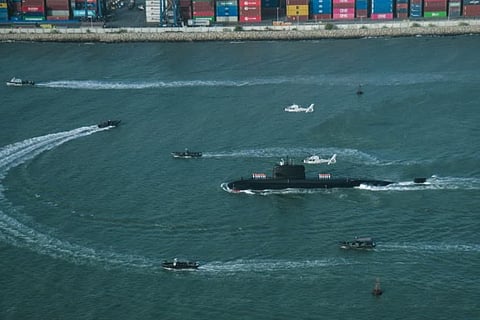

NEW DELHI: India is moving to plant eyes and ears on the Indian Ocean seabed. The Defence Research and Development Organisation has kicked off the hunt for an industry partner to develop and deploy an Underwater Fiber Optic Sensing System (UFOSS), a fixed network of undersea sensors that will keep round-the-clock watch on submarines prowling India’s waters.
The Kochi-based Naval Physical and Oceanographic Laboratory (NPOL), DRDO’s premier underwater warfare lab, has floated an expression of interest (EOI) to identify a “lead system integrator” for the turnkey development, supply, transportation, deployment and commissioning of the system. The network will comprise seabed sensor nodes linked by subsea fibre-optic cables to a shore station where the data will be received, monitored and analysed.
An EOI is only the first stage of the procurement process, issued on a “no cost, no commitment” basis to gauge industrial capability. But it marks the government’s first public move towards what could eventually become a strategic underwater sensing grid. Based on the responses, NPOL will float a request for proposal (RFP), with the lowest qualified bidder to bag the contract.
The move comes with the undersea battlespace in the Indian Ocean Region (IOR) getting increasingly contested. Chinese nuclear and conventional submarines periodically prowl the IOR, while Chinese survey and “research” vessels systematically map the region’s waters, data invaluable for future submarine operations. Pakistan, in turn, has also begun inducting eight Chinese-origin Hangor-class diesel-electric submarines with air-independent propulsion (AIP), the first of which has already been launched.
India’s own underwater modernisation, in contrast, remains years away from bridging the gap. The Navy does not currently operate a nuclear-powered attack submarine (SSN), with the lease of the Russian Akula-class Chakra III delayed by more than three years. The indigenous programme to build two SSNs, cleared by the Cabinet Committee on Security (CCS) in October 2024 at an initial cost of around Rs 40,000 crore, is expected to take well over a decade before the first boat enters service. The Project-75I programme for six advanced conventional submarines is also yet to receive the CCS’s final approval and, even after the contract is signed, the first submarine is unlikely to be delivered for around seven years.
Submarines are inherently the most potent anti-submarine warfare (ASW) platforms, silent hunter-killers best equipped to stalk enemy boats. But with a depleted and ageing conventional fleet of both subs and ASW choppers, the Navy has to lean on a layered grid of P-8I maritime patrol aircraft, MH-60R multi-role helicopters, warships and surveillance systems. Fixed seabed sensors like UFOSS will plug a critical gap in that grid.
Unlike ships and aircraft that patrol an area only periodically, seabed sensor networks keep watch round-the-clock, silently monitoring underwater activity and cueing ASW assets towards potential contacts.
The concept has well-established precedents. During the Cold War, the United States deployed the Sound Surveillance System (SOSUS), a network of seabed-mounted hydrophone arrays connected by undersea cables to detect and track Soviet submarines. The US and Japan later expanded similar underwater surveillance architecture across the western Pacific to monitor Chinese submarine movements, while China has built its own “underwater Great Wall” of seabed acoustic sensors in the South China Sea.
According to the EOI, the UFOSS will comprise underwater “wet-plant” systems including sensor array nodes, subsea fibre-optic cables, junction boxes and branching units linked through a beach manhole to a shore station. The selected integrator will be responsible for the entire project, from integration and deployment to commissioning, one year of operations and lifecycle support for the system’s planned 20-year service life. Execution has been tentatively pegged at 48 months.
The proposals for this project are due by September 1, with consortiums of up to five companies besides the lead bidder allowed to pool specialised capabilities. Bidders will also need proven expertise across subsea cable manufacturing and deployment, underwater systems, marine surveys, system integration and shore monitoring stations, backed by assets like dedicated cable-laying ships, remotely operated vehicles (ROVs) and cable burial ploughs.
