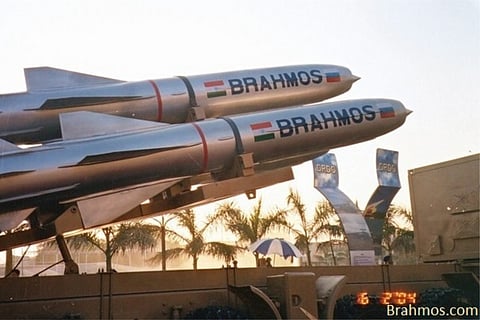

NEW DELHI: A missile with no foreign buyer until 2022 now has two contracted customers, a third in the pipeline and at least half a dozen countries in the queue.
The BrahMos, the only supersonic cruise missile available for export anywhere in the world, has emerged as the flagship of India’s defence export push, with the Memorandum of Understanding (MoU) inked with Indonesia on Tuesday marking the latest step in a rapidly expanding footprint.
The Philippines opened the account with a $375-million contract for shore-based anti-ship missile batteries in 2022 and has since taken deliveries. Vietnam came next, with Defence Secretary Rajesh Kumar Singh confirming at the Shangri-La Dialogue in Singapore earlier this year that the deal, estimated at around $629 million, had “already been signed, probably not publicly announced”.
Indonesia is now set to become the third customer. The newly signed MoU between BrahMos Aerospace and the Indonesian defence ministry provides the overarching framework for phased procurement of two batteries estimated at around $200 million, with formal contracts to follow, sources in the defence establishment said.
A battery typically comprises four mobile autonomous launchers and 12 ready-to-fire missiles, backed by command posts, radars and support vehicles, though configurations vary between land-based regiments and coastal defence batteries.
The buyers’ list has a discernible pattern. All three countries are locked in maritime disputes with China in the South China Sea, and have turned to the missile to stiffen deterrence against Beijing’s expanding naval presence. China has earlier objected to such sales as interference in disputed waters.
Export interest has sharpened since the missile’s combat debut during Operation Sindoor last year, when precision strikes punched through Pakistan’s largely Chinese-origin air defence network.
India is now negotiating with the United Arab Emirates (UAE) for both BrahMos and the Akashteer air defence command and control system, with Abu Dhabi keen to cut dependence on Western suppliers after the recent Iran conflict, even as the Saudi-Pakistan mutual defence pact reshapes strategic equations in the Gulf. In a telling turn, Russia, its missile stocks depleted by the Ukraine war, is also learnt to be considering induction of BrahMos on its own naval platforms.
The Russian factor
The joint venture structure, however, imposes its own constraints on exports. The missile, which flies at Mach 2.8 with a 290-km range and can be launched from land, warships, submarines and Sukhoi-30MKI fighters, is produced by BrahMos Aerospace, set up in 1998 between the Defence Research and Development Organisation (DRDO), which holds 50.5 per cent, and Russia’s NPO Mashinostroyeniya, which holds 49.5 per cent.
Moscow’s concurrence is required for every third-country sale, which Russian Defence Minister Andrey Belousov conveyed for the Vietnam and Indonesia deals during talks with Defence Minister Rajnath Singh in Dec 2024.
Export variants also remain capped at 290 km under the guidelines of the Missile Technology Control Regime (MTCR), though India, a member of the regime since 2016, has developed extended-range versions beyond 450 km for its own forces.
BrahMos Aerospace, in turn, is working to cut costs by nearly 20 per cent over the next two years, while developing the lighter 1.2-tonne BrahMos-NG (Next Generation) for integration on a wider range of platforms. With India targeting Rs 50,000 crore in annual defence exports by 2029, the missile that once had no takers is now the calling card.
