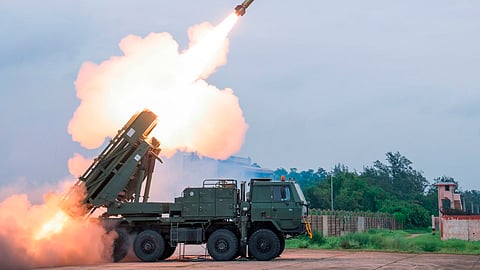

NEW DELHI: The Army’s quest for long-range ‘shoot-and-scoot’ firepower to hit enemy gun positions, command centres and logistics hubs deep across the borders got a boost on Wednesday, with the Defence Research and Development Organisation (DRDO) successfully testing the 120-km Pinaka guided rocket for its user-specified minimum range of 60 km at Chandipur off the Odisha coast.
“Demonstrating all in-flight manoeuvres as planned, the LRGR (long range guided rocket) impacted the target with textbook precision, exactly following the predicted trajectory,” the defence ministry said.
Crucially, the rocket was fired from an in-service Pinaka launcher, validating the Army’s requirement that variants of different ranges be fired from the same platform without new launch infrastructure.
The latest trial follows the maiden flight test of the LRGR-120 in December last year, when the rocket was fired to its maximum range of 120 km.
The ‘minimum range’ test, in turn, is as crucial as the maximum reach for the Army. A rocket geared to zoom to 120 km has to shed enormous energy and execute steep manoeuvres to accurately hit a target just 60 km away. It also ensures the launchers have no ‘dead zone’ in front of them, with the same rocket capable of taking out enemy artillery positions, radars and command posts across the entire 60-120 km envelope without the need for a separate weapon system.
The LRGR, developed by the Armament Research and Development Establishment (ARDE) with the High Energy Materials Research Laboratory, DRDL and Research Centre Imarat, will more than double the reach of guided Pinaka variants, allowing the Army to strike targets deep across the borders with Pakistan and China. DRDO is also learnt to be working on follow-on 300-km and 450-km versions.
The Defence Acquisition Council (DAC), chaired by defence minister Rajnath Singh, had cleared the LRGR project the same day as the maiden test, as part of procurement proposals worth about Rs 79,000 crore. The Army’s project to induct the 120-km rockets, compatible with existing launchers, is pegged at around Rs 2,500 crore.
The Army currently operates seven Pinaka regiments, with the eighth set to be operationalised by the end of the year. In artillery parlance, a regiment typically comprises three batteries, each operating six launchers, giving a regiment 18 launchers in combat configuration, with two additional launchers maintained for training and wartime replacement.
A single battery of six launchers can fire 72 rockets in about 44 seconds, saturating an area of roughly 1,000 by 800 metres.
At present, the Army fields about 15 rocket artillery regiments across three platforms including seven Pinaka, three Russian-origin Smerch and five older BM-21 Grad units. The plan is to gradually replace the ageing Grads with additional Pinaka units, expanding the fleet to about 22 regiments in the long term. Pinaka has also notched export success with Armenia, other countries showing interest.
