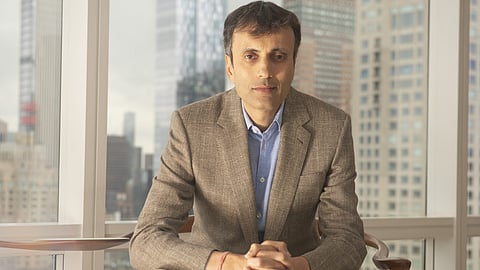

Ruchir Sharma, Chairman of Rockefeller International and founder of Breakout Capital, is a leading investor, economist, and bestselling author. In conversation with Jayanth Jacob, he explores AI, India’s economic outlook, global trade, manufacturing, the China+1 strategy, the future of jobs, the India-US partnership, and the geopolitical forces shaping the global economy. Excerpts:
India is signing AI partnerships from France to Japan. Will these deals build real AI capability at home, or are they mainly geopolitical positioning in a US-China-dominated race?
Currently, we are in that phase of AI where the countries that are benefitting are those producing the AI infrastructure. This includes Large Language Models (LLMs), the required hardware, semiconductors, servers, and very large data centres. Countries with significant strengths in these areas are benefitting. It just happens that this has not been India’s strength. India’s tech ecosystem has never been particularly strong on the hardware side. Historically, India’s strength in technology has been built on software. But this phase of AI is all about hardware.
It’s not just the US or China. As I said, countries like Japan, Korea, Taiwan, and Israel are also doing well because they have significant exposure to the AI ecosystem. They have built their tech ecosystems over a long period and have invested heavily in technology, particularly in research and development. If you look at the data, these countries’ tech investment is closer to 4% of GDP, while their R&D spending is around 3% of GDP. In Israel’s case, it is as high as 6%. In India, by contrast, the numbers are closer to 1%, if not lower. You cannot close this gap overnight. It takes a long time.
This brings us to a follow-up question: Is India’s diversified AI strategy the key to strategic autonomy, or does it risk spreading limited resources too thin?
I think diversification is the right approach because it is very hard to be overly reliant on any single country at this point. The level of trust is such that India will naturally do more with America than with China because of historical trust levels. Even though relations between America and India have not been in the best shape of late, I would say the trust deficit with China is still much larger. They are trying to close it, but it remains so significant that it is very difficult for India to rely too much on China in this area. So having as much strategic autonomy as possible, and maintaining ties with multiple countries, is the right approach.
If AI begins to disrupt white-collar employment at scale, how should India think about job creation when services and IT—its traditional strengths—may no longer absorb labour in the same way?
My view has long been that AI—or, for that matter, any technological revolution—does not kill jobs; it kills professions. I don’t think the impact is going to be as dire as many fear. There is also a tendency, not just in India but in America and elsewhere, to focus on what is being destroyed rather than on what is being created. And it is often easier to see what is being destroyed than what is being created.
Even in America, there was a lot of fear that employment would decline because of AI. We have not seen much evidence of that so far. In sectors such as healthcare, data centres, and similar areas, employment is actually increasing, even if it is declining in some entry-level IT services jobs. So, I don’t think AI is going to be a major job killer everywhere. If it does become that, I think the political backlash against AI will be huge.
I am relying on the lessons of previous technological revolutions. If you look at all the major transitions we have seen, new jobs are created, professions disappear, but jobs do not vanish on a net basis. There is also the concept of the Jevons paradox, which holds that technological progress increases efficiency, leading to higher overall consumption rather than lower consumption. So, efficiency gains do not necessarily reduce employment in the long run. This narrative is still far from settled because it keeps shifting back and forth.
Like AI, “China+1” and supply chain diversification are heard everywhere. Is the shift away from China real, or is the narrative outpacing reality? And is India poised to capitalise on it in any meaningful way?
Unfortunately, India has not seen much benefit from this. In fact, the biggest beneficiaries of the China+1 strategy have been countries like Vietnam and South Korea, because of the AI boom. We have not seen anything meaningful on that front. That is because, as I have argued in the past, India is still a very tough place to do business, especially for foreigners looking to invest here. It is a very challenging environment.
If you look at the gross FDI numbers—or even the net FDI numbers—I tend to look at the gross figures because many people argue that net FDI is not the right measure, given the amount of money flowing out. But even on a gross FDI basis, the picture is similar. Among the 25 largest emerging economies that we track, India ranks 19th in net FDI. If you look at gross FDI, the rankings are very similar.
What still prevents India from capturing a larger share of global manufacturing—regulation, infrastructure, labour markets, or scale?
I feel that, at the end of the day, India is still a very tough place to do business. I have people here in America who talk about it, and they do not know which way to go. Coordination between the Centre and the states can sometimes be difficult. Even at the local level, execution is very tough.
I also think there is a slight feeling among policymakers that, where else will the money go? It has to come to India because the market is so large. That underlying attitude, I think, prevents the most efficient policymaking. When you assume the money has nowhere else to go because India’s market and consumer base are so large, that is what leads to problems.
Are India and the US now structurally aligned against China, or are they still vulnerable to Washington’s politics? And how much does the Modi-Trump equation matter in shaping the relationship?
There is definitely a natural affinity between India and America, given the very large and highly successful Indian diaspora here. There is also a great deal of admiration in the United States for Indians, particularly at the highest levels. There has, of course, been some increase in animosity around the labour and wage-arbitrage debate. Even so, I feel this natural affinity is likely to outlast any administration. There will be ebbs and flows, but I do not see the relationship changing in any fundamental way. So, I still feel that these are bigger dynamics than anything else.
Coming to the Trump-Modi dynamics, there has been a stark contrast between the first and second terms. Too much has happened for the relationship to return to the more straightforward phase of the first term. That said, it seems to me there has been something of a pause in recent tensions. President Trump is, at the end of the day, a very transactional president, so he can always change his mind very quickly.
Looking ahead, say, five years, what widely accepted belief about AI, global trade, or geopolitics do you think history will prove wrong—and why?
I believe we are in an AI bubble. Five years from now, I think what will prove wrong is the belief that the entire world order will be built solely around AI. There is a growing sense that AI has become the foundation of the next world order, and I think that is too unifocal a view. I don’t believe that is how the world is going to play out.
I am a huge believer in AI as a technology, and I think it will be transformative. But I don’t believe the entire world will be defined by an “AI or bye-bye” mindset—the idea that you either go all-in on AI or you are left behind. That kind of unifocal, almost monomaniacal view is, in my opinion, not going to hold true five years from now.
