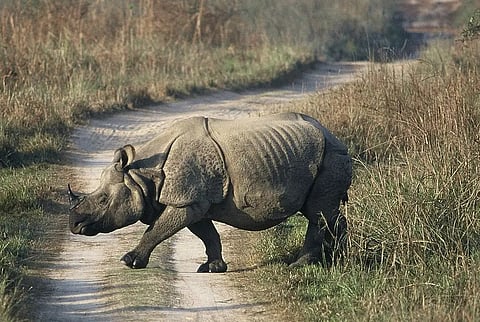

NEW DELHI: The Centre on Thursday approved a landmark conservation initiative to create a DNA-based indexing system for the greater one-horned rhinoceros, a move aimed at strengthening species conservation, improving wildlife management and curbing poaching through scientific monitoring.
The decision was taken at the 91st meeting of the Standing Committee of the National Board for Wildlife (SC-NBWL) chaired by Union Environment Minister Bhupender Yadav. The committee also approved the inclusion of the Pygmy Hog under the ‘Species Recovery Programme’ and reviewed the future conservation strategy for the critically endangered ‘Great Indian Bustard (GIB)’.
The proposed Rhino DNA Indexing System will create a genetic database of India’s one-horned rhinos, enabling authorities to identify individual animals, map their geographical distribution, determine age and sex, and monitor genetic diversity across protected habitats. Wildlife experts say the initiative will help detect the movement or mixing of rhino populations between forests, support scientific breeding programmes and provide forensic evidence to investigate wildlife crimes.
The move mirrors India’s successful DNA profiling programme for tigers, which has become an important tool in tracking tiger populations and investigating poaching cases.
The rhino initiative forms part of the government’s broader push towards science-based wildlife conservation, as the Standing Committee reviewed progress on several directions issued by the National Board for Wildlife (NBWL), including decisions taken at its seventh meeting chaired by Prime Minister Narendra Modi.

Addressing the meeting, Yadav said wildlife conservation must remain at the core of India’s environmental governance. “Wildlife conservation remains central to India’s environmental governance, and scientific planning, habitat connectivity and effective mitigation measures should continue to guide decision-making regarding developmental projects in and around wildlife habitats,” he said.
The minister also emphasised the need for ‘solution-oriented policy interventions’ combining modern technology, scientific research, sociological studies and traditional knowledge to strengthen conservation outcomes.
Apart from approving the Rhino DNA Indexing System, the committee reviewed conservation strategies for the Great Indian Bustard, and assessed the progress of species recovery programmes for several threatened animals. It also released scientific publications on the conservation of the rhinoceros, sloth bear and Great Indian Bustard.
Yadav later highlighted encouraging progress under “Project Great Indian Bustard,” saying the second “jump start” attempt in Gujarat’s Naliya landscape had succeeded. “The project will soon enter the rewilding phase, and efforts are underway. The teams from the Wildlife Institute of India and the State Forest Departments of Rajasthan and Gujarat are leaving no stone unturned to ensure the project’s success,” Yadav said.