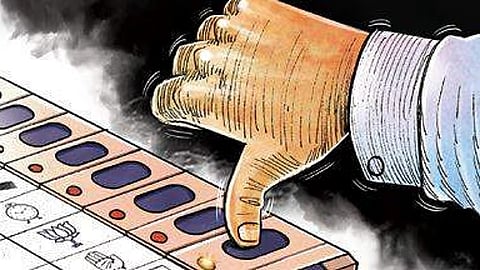

The Joint Parliamentary Committee (JPC) examining the bills on simultaneous elections is working to evolve a mechanism that could make the proposed 'One Nation, One Election' reform operational by the 2029 Lok Sabha elections, its chairperson PP Chaudhary said on Friday.
Speaking to reporters on the sidelines of the panel's two-day meeting in Goa, Chaudhary said the committee was consulting stakeholders across the country to build consensus on the proposed electoral reform. He claimed that nearly 99 per cent of the civil society stakeholders consulted so far had supported the proposal.
The committee on Friday interacted with Goa Chief Minister Pramod Sawant and members of his Cabinet to seek their views on the challenges involved in implementing simultaneous elections and ways to address them.
"We had an informal interaction with the chief minister and cabinet ministers, who represent the people of Goa. We discussed how 'One Nation, One Election' can be implemented, what challenges exist and how they can be mitigated while maintaining a fine balance acceptable to all," Chaudhary said.
The BJP MP from Rajasthan's Pali constituency said the committee had also held consultations in Gujarat, Karnataka, Maharashtra, Himachal Pradesh, Uttarakhand, Punjab, Haryana and Delhi with constitutional experts, civil society organisations, educationists and other stakeholders.
"We have found that almost 99 per cent of stakeholders, particularly from civil society and various organisations, favour simultaneous elections. The effort now is to evolve a mechanism that is acceptable to all political parties," he said.
On the timeline for implementation, Chaudhary said the panel was examining various options and indicated that the reform could be rolled out by the next general elections in 2029.
He said there was also the possibility of bringing some States into sync before then if political parties and chief ministers voluntarily agreed to align their electoral cycles.
Highlighting the economic case for simultaneous elections, Chaudhary referred to findings submitted to the high-level committee headed by former President Ram Nath Kovind. He said the study estimated that holding elections separately across the country results in an economic loss of nearly Rs 7 lakh crore, while synchronised elections could generate equivalent gains for the economy.
"Elections are now not confined to one state. If elections are held anywhere in the country, they have an impact on other states because the economy is interconnected," Chaudhary said.
Using Goa as an example, he said elections in major States affected tourist arrivals in Goa, while elections in the coastal State itself impacted its tourism industry.
"The economy today is globalised. An adverse impact in one state affects other states as well. Frequent elections have economic consequences beyond state boundaries," he said.
Chaudhary also said frequent elections disrupted governance and affected education, as teachers were routinely deployed for election-related duties, including electoral roll preparation, training and polling work.
"As a result, teaching in government schools suffers. The worst affected are children from economically weaker sections who depend on government schools. This is a serious concern if the situation continues over the coming decades," he said.
Describing simultaneous elections as a "major electoral reform" envisioned by Prime Minister Narendra Modi, Chaudhary said it would help India achieve its goal of becoming a developed nation by 2047.
"The details will emerge with time. The objective is to build a broad consensus and evolve a practical mechanism acceptable to all," Choudhari said.
(With inputs from PTI)
