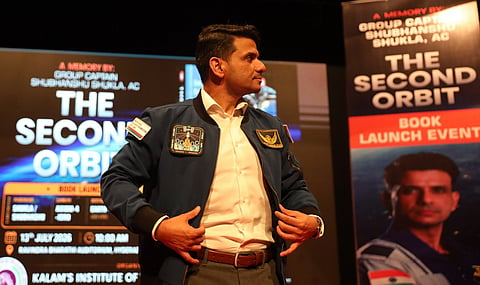

India's second astronaut to travel to space, Group Captain Shubhanshu Shukla, says the country's next decade in space exploration will be defined by ambitious human spaceflight missions, indigenous launch capabilities, and the eventual construction of an Indian space station.
Speaking exclusively to TNIE’s Khyati Shah, during the launch of his book 'Second Orbit' in Hyderabad, Shukla reflected on his journey from a classroom to space, the pride of representing India aboard the International Space Station, the scientific experiments conducted for India's future missions, and his message to the next generation to stay focused and persevere.
Excerpts:
Why did you choose the title 'Second Orbit'? What is the idea behind the name?
The title Second Orbit is a tribute to India's first astronaut, Rakesh Sharma, who travelled to space in 1984 aboard the Soviet space station Salyut 7. His mission marked India's first human presence in space. It then took 41 years for another Indian to travel to space, and my journey became part of what I call India's "second orbit." The title symbolises not just my mission but also acknowledges the legacy of the first mission and the continuation of India's human spaceflight journey. It is my way of paying tribute to that historic achievement while looking ahead to the future.
Does the book contain stories or experiences that you have never spoken about publicly?
Yes, quite a few. Whenever I interact with students, young people or audiences during public events, the conversations are usually brief. There is never enough time to explain the complete journey or discuss the experiences that shaped me. The book gives me the opportunity to tell those stories in detail—from my days in the classroom and my training as a fighter pilot to eventually becoming an astronaut. It also talks about the challenges, the preparation, the emotions, and many behind-the-scenes moments that people have never heard before. I hope readers enjoy that personal side of the journey.
Looking back at your time aboard the International Space Station, is there one moment that stands out as your proudest?
There are many unforgettable memories, but one moment stands above the rest. It was the day I interacted with Prime Minister Narendra Modi from the International Space Station. As I prepared for that interaction, I realised that for the first time, the Indian flag was being represented in that manner aboard the ISS, and Hindi was being spoken from the station during an official interaction. It wasn't just a personal milestone; it represented India's growing presence in global space exploration. That memory has stayed with me, and I believe every Indian shared that sense of pride.
You conducted several scientific experiments in space. Which of them do you think will have the greatest impact on India's future space programme?
During my mission, I carried out seven scientific experiments designed by Indian researchers. They covered different scientific disciplines, but they all had a common objective—to support India's future human spaceflight programme. These studies will contribute to the knowledge and technologies required for long-duration human missions and future Indian astronauts. Rather than identifying one experiment as more important than the others, I believe each one is a vital building block in preparing India for its own sustained human space exploration programme.

Where do you see India in terms of human space exploration over the next decade?
I believe the coming decade will be one of the most exciting periods in India's space journey. We already have a clear roadmap through programmes such as Gaganyaan and the missions that will follow. We will soon see Indians travelling to space aboard Indian launch vehicles from Indian soil. Beyond that, there are plans for an Indian space station and eventually human missions to the Moon. These are not just technological milestones—they will create tremendous opportunities for young scientists, engineers and students who dream of contributing to India's space programme. I am genuinely excited about what lies ahead.
Hyderabad has emerged as one of India's leading aerospace and defence hubs. Why did you choose Hyderabad for the launch of your book?
I wanted to launch the book in several cities across the country because I want it to reach readers everywhere. Hyderabad was a natural choice because it has developed into one of India's most important aerospace and defence ecosystems. But it is also a very personal city for me. My flying career began here at the Indian Air Force Academy in Dundigal, on the outskirts of Hyderabad. This city played an important role in shaping my professional journey. Coming back here to launch the book felt like completing a full circle—from where my aviation journey began to sharing the story of my journey into space.
What lies ahead for you? Can you share anything about your upcoming work or future missions?
A great deal is happening, and we will continue to share updates as things progress. At the moment, however, our foremost priority is Mission Gaganyaan. That is where our collective focus lies. It is an extremely important mission for India, and all our efforts are directed towards making it a success.
You spent time interacting with students today. What message would you like to leave with the younger generation?
Every time I meet young people, I am impressed by how intelligent, curious and capable they are. The biggest challenge today's generation faces is not a lack of ability but the sheer number of distractions competing for their attention. My advice is to identify what truly matters to them and remain focused on it. The second lesson is perseverance. Real success comes from staying committed to a goal over a long period, even when progress seems slow. If young people can learn to focus and develop the habit of not giving up, they can achieve extraordinary things in whichever field they choose.