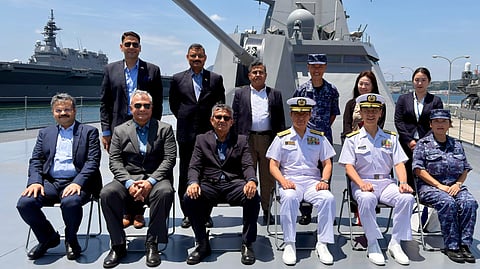

NEW DELHI: Amid Japan’s historic loosening of its post-war arms export curbs, Defence Secretary Rajesh Kumar Singh visited the Japan Maritime Self-Defense Force’s (JMSDF) JS Niyodo during his trip to Japan, as Tokyo steps up efforts to secure an Indian order for its Mogami-class stealth frigates through an offer of technology transfer and local production.
Singh toured the seventh Mogami-class frigate at the Kure naval base in Hiroshima and met Vice Admiral Matsumoto Tamotsu, Commandant of the Kure District. “The visit reaffirmed the commitment of India-Japan to further strengthen maritime security cooperation and deepen defence ties,” the defence ministry said Tuesday.
The choice of platform was significant. The frigate is the first Mogami-class frigate built with the Mk 41 vertical launching system from the outset and the first of the class to be based at Kure, one of Japan’s five principal naval bases overlooking the East China Sea.
The visit comes as India evaluates Japan’s proposal to manufacture the Mogami-class frigates domestically under the ‘Make in India’ initiative.
Sources in the know told TNIE that Tokyo has offered to transfer the design and production rights for the warships, along with critical technologies, marking a significant departure from Japan’s traditionally restrictive defence export policy.
The proposal is also understood to include integration of Indian systems such as the BrahMos supersonic cruise missile, with construction likely to be undertaken by either Mazagon Dock Shipbuilders or Garden Reach Shipbuilders & Engineers. If it materialises, it will be Japan’s first major defence platform export to India.
The Japanese offer comes after Australia selected an upgraded Mogami-class design under Australia’s SEA 3000 General Purpose Frigate programme, giving Tokyo its biggest overseas naval export opportunity to date.
The 3,900-tonne frigates, with a full-load displacement of about 5,500 tonnes, are designed for multi-role operations with a crew of around 90 because of extensive automation.
They are equipped with a 127 mm Mk 45 gun, Type 17 anti-ship missiles, a SeaRAM close-in weapon system and a 16-cell Mk 41 vertical launching system, while propulsion is provided by a combined diesel-and-gas arrangement centred on a Rolls-Royce MT30 gas turbine.
The proposal will also be weighed against the Navy’s indigenous warship-building plans. With the seven Project 17 Alpha frigates nearly completing commissioning and a follow-on Project 17 Bravo programme under consideration, introducing a new foreign design would create a parallel logistics and maintenance chain, despite Japan’s reported offer of full technology transfer.
The stop at Kure followed Singh’s meetings in Tokyo with Japanese Defence Minister Shinjiro Koizumi and Vice Minister Kano Koji, during which the two sides reviewed regional security, maritime cooperation, defence industrial collaboration, cyber security and space cooperation.
The visit also built on Japanese Prime Minister Sanae Takaichi’s visit to India earlier this month, during which Bharat Electronics Limited signed an agreement for the co-development of the UNICORN integrated mast system already fitted on the Mogami-class frigates amid China’s growing maritime presence in the Indo-Pacific.
