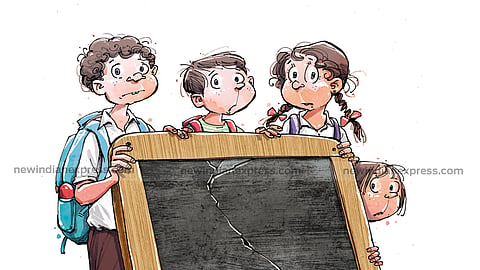

NEW DELHI: India's school education system continues to make steady progress in expanding access to education, strengthening school infrastructure, improving teacher availability and reducing school dropout.
However, while more children are entering and staying in school through the elementary years, the latest Unified District Information System for Education Plus (UDISE+) 2025-26 report highlights that the most pressing educational challenge is ensuring children remain in school through secondary education.
According to an analysis of UDISE+ 2025-26 database done by CRY – Child Rights and You, an NGO working on child rights in the country, at every educational level, boys have higher dropout rates than girls, with the difference widening significantly during secondary education level.
The gender gap in school dropouts observed at the secondary level is 8.3% for boys, and 5.7% for girls, indicating that adolescent boys are more likely to drop out at the secondary level.
India has 14.67 lakh schools, serving 24.72 crore students with the support of 1.03 crore teachers, making it one of the largest school education systems in the world.
The report further highlights educational continuity weakens considerably during adolescence.
The Gross Enrolment Ratio (GER) declines from 91.7 per cent at the preparatory stage and 89.6 per cent at the middle stage to 71.7 per cent at the secondary stage, indicating that nearly three out of every ten adolescents of official secondary-school age remain outside the education system.
Similarly, although 98.5 per cent of children entering the foundational stage are expected to complete that stage, only 51.9 per cent are expected to remain in school through Class XII, highlighting the continuing challenge of ensuring children complete secondary education.
Digital inequalities despite improvements in school infrastructure is another area that requires further attention, as per the UDISE+ Report.
Although nearly seven in ten schools now have computers and internet access, significant inter-state disparities persist, particularly in West Bengal, Meghalaya, Arunachal Pradesh, Bihar and Manipur, limiting equitable access to digital learning opportunities.
The report also highlights that the national averages often conceal wide regional disparities.
States such as Andhra Pradesh, Kerala, Tamil Nadu, Telangana and Maharashtra continue to perform well across indicators including educational participation, transition rates, retention and infrastructure.
In contrast, Bihar, Meghalaya, Arunachal Pradesh, Jharkhand, Assam, Madhya Pradesh and Uttar Pradesh continue to record below-national-average performance across multiple educational indicators, reflecting persistent inequalities linked to geography, socio-economic conditions and access to quality education.
The report showed that while teacher availability has improved nationally, teacher deployment continues to remain uneven.
States such as Jharkhand (Pupil-Teacher Ratios (PTR) 36), West Bengal (30), Gujarat (29), Maharashtra (29) and Bihar (28) report significantly higher ratios than the national average of 24, indicating greater classroom pressure in these states despite overall national progress.
Commenting on the report, Puja Marwaha, CEO, CRY said, “The UDISE+ 2025–26 findings reinforce that India has made significant progress in expanding access to education and improving school infrastructure over the past few years."
"However, the report also reminds us that enrollment alone cannot be our measure of success. The real test lies in ensuring that every child – especially adolescents – remains in school and completes secondary education. Persistent regional disparities, gaps in foundational learning, barriers faced by children with disabilities, and unequal access to quality secondary education continue to prevent many children from realising their full potential.”
“As India advances towards the targets set by the Sustainable Development Goal 4, greater policy attention and investments must now focus on educational continuity, equity and school completion, so that no child is left behind," Puja added.
The report also reflects some encouraging improvements across several key educational indicators.
National dropout rates have declined substantially over the past four years, reaching 1.8 per cent at the preparatory stage, 3.6 per cent at the middle stage, and 7.0 per cent at the secondary stage in 2025–26. Transition rates have also improved consistently, with 99.2 per cent of children successfully progressing from the foundational to preparatory stage, 93.8 per cent moving from preparatory to middle stage, and 88.3 per cent entering secondary education.
School infrastructure too has strengthened considerably. Nationally, 95.0 per cent of schools have electricity, 99.5 per cent provide drinking water, 98.5 per cent have girls' toilets, and 96.9 per cent provide handwashing facilities.
Access to digital infrastructure has also expanded, with 69.9 per cent of schools equipped with computers and 67.4 per cent having internet connectivity, reflecting steady progress towards technology-enabled learning.
Teacher availability continues to improve as well. The national Pupil-Teacher Ratio (PTR) remains well within the norms recommended under the National Education Policy (NEP) 2020 across all stages of school education, standing at 10:1 at the Foundational stage, 12:1 at the Preparatory stage, 17:1 at the Middle stage, and 21:1 at the Secondary stage.
Government schools continue to remain the backbone of public education, accounting for 68.5 per cent of all schools and educating 48.1per cent of all enrolled children, reaffirming their critical role in ensuring equitable access to education, particularly for children from rural, remote and socio-economically disadvantaged communities.
Gender parity presents a relatively encouraging picture nationally.
Girls account for 48.4 per cent of total enrolment, compared with 51.6 per cent for boys, and generally record slightly higher Net Enrolment Rates across several educational stages.
