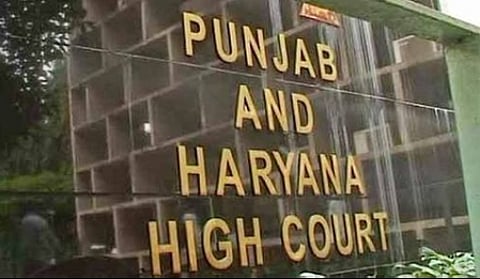

CHANDIGARH: Sloganeering against the government or any wing of governance in an elected democracy would not be sufficient grounds to slap sedition charges against citizens, the Punjab and Haryana High Court has held.
A slogan against the government is only a means of expressing dissent and not hatred/contempt or disaffection, it observed while upholding the acquittal of four Kaithal residents in connection with an incident in 2017 after Dera Sacha Sauda chief Gurmeet Ram Rahim Singh's conviction in a rape case.
A violent protest may amount to rioting, but such acts of violence would not be perceived as an act of bringing in hatred or contempt against the government, the high court observed.
The FIR had been registered on August 25, 2017, under sections including 124-A (sedition), 188 (disobedience of a lawful order), 120-B (criminal conspiracy) of the Indian Penal Code (IPC), along with the provisions of the Prevention of Damage to Public Property Act at Kalayat police station in Kaithal.
A mob had allegedly vandalised an electricity office in Haryana's Kaithal in the violence that erupted after Gurmeet Ram Rahim Singh's conviction by a court in Panchkula.
A bench of Justices Vinod S Bhardwaj and Sukhvinder Kaur dismissed Haryana authorities' appeal challenging a trial court verdict of September 23, 2019, acquitting the accused of offences under various IPC Sections including 124-A (sedition).
"Still further, even the ingredients of Section 124-A IPC are not satisfied. A violent protest may amount to rioting but such action of violence would not be perceived as an act of bringing in hatred or contempt against government," observed the high court in its order dated July 2.
Sloganeering against the government or wings of governance, in an elected democracy, would not be sufficient to slap charges of sedition against its citizens, the bench observed.
"A frustration or dissatisfaction or even outrage is not a disaffection or hatred. Court is hence required to ensure that when the charge becomes grave and the punishment harsh, the ingredients and their existence is strict.
"The evidence on record is merely suggestive of slogan against the government, which is only a means of expressing dissent and not hatred/contempt or disaffection," the HC bench observed.
The bench was told that the FIR was registered after a power utility UHBVN's Sub-Divisional Officer, Kalayat, had complained that about 14-15 persons, armed with lathis, 'gandasas' and bottles containing petrol, proceeded towards the office in August 2017 while raising slogans.
Apprehending danger to their lives, the officer concerned and other officials left the premises.
The court also observed that no test identification parade was ever conducted, despite the claimed position that none of the witnesses had any prior acquaintance with the accused persons.
The accused were identified for the first time during their appearance in court.
In criminal jurisprudence, where the identity of an accused constitutes the foundation of the prosecution case and the witnesses are strangers to the accused, holding of a test identification parade assumes considerable importance, the HC bench observed.
The high court said it is evident that the trial court has not acquitted the respondents merely on account of minor discrepancies but the acquittal is founded upon substantial contradictions, material omissions, doubtful recoveries and lack of reliable identification.
It also cited "inconsistent investigation, absence of forensic corroboration and failure of the prosecution to establish the statutory ingredients of several offences alleged against the respondents".
The HC said that the burden lay squarely upon the prosecution to establish the guilt of the respondents beyond all reasonable doubt but it has failed to cross over from a broad suspicion of the accused "may have been" involved to the legal requirement of an accused "must be involved" in the offences.
Suspicion and suppositions are probabilities and not proof, the High Court bench further observed.
"Accordingly, we find no illegality, perversity, impropriety, misreading of evidence or miscarriage of justice in the judgment of acquittal recorded by the trial court warranting interference by this Court in exercise of its appellate jurisdiction.
"The present appeal is, therefore, devoid of merit and is hereby dismissed. The judgment of acquittal passed by the trial court is affirmed," the HC said.
