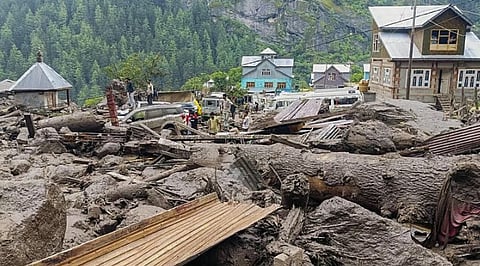

SRINAGAR: As a consequence of climate change, Jammu and Kashmir witnessed at least 15 to 16 cloudbursts within a fortnight after the monsoon set in. Flash floods, mudslides and landslides caused extensive damage to agricultural land and public and private property.
The latest incident occurred on July 11 when a cloudburst struck the Awoora area of the Pahalgam tourist resort in south Kashmir’s Anantnag district. It triggered flash floods that inundated residential areas, damaged agricultural fields and gushing water entered hotels.
Tourists staying in the hotels were rescued by hotel staff and locals and shifted to safer locations. On July 7, a cloudburst triggered a flash flood and mudslide in Thathri town of mountainous Doda district.
According to officials, 20-25 houses and 41 shops were damaged in the flash flood. Many vehicles were also damaged after being trapped in debris, while a few were swept away in the Chenab River. North Kashmir’s remote Tulail Valley and Gurez, close to the LoC, were also hit earlier this month.
According to Director of Met Kashmir Dr Mukhtar Ahmad, about 15-16 cloudbursts have taken place in J&K since the onset of the monsoon in the first week of July.
“The increasing frequency of such incidents is consistent with broader impacts of climate change and global warming. In the context of climate change and global warming, it is expected that the frequency of cloudbursts will increase in the future,” he said.
Ahmad said tracking localised weather is very difficult, and there is no weather system or model across the world to predict cloudbursts. The weather system, he said, cannot predict sudden changes in the weather system.
Climate change
“The increasing frequency of such incidents is consistent with broader impacts of climate change and global warming. In the context of climate change and global warming, it is expected that the frequency of cloudbursts will increase,” Director of Met Kashmir Dr Mukhtar Ahmad said.
