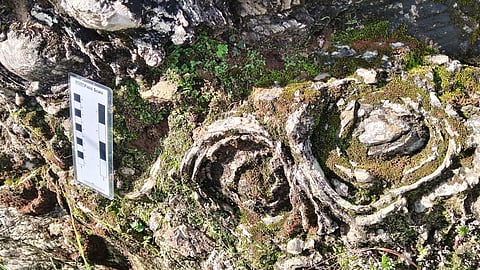

DEHRADUN: Ancient stromatolite fossils, dramatic Himalayan landscapes and a rich mix of biodiversity and culture could make border district Pithoragarh India’s first UNESCO Global Geopark, researchers said at an awareness programme in KMSB Himalayan Inter College on Friday.
A research team from Ram Lal Anand College, University of Delhi, highlighted the district’s geoheritage at KMSB Himalayan Inter College. The initiative aimed to familiarise students, teachers and local communities with geotourism, conservation and sustainable development.
Researchers said Pithoragarh and the adjoining areas of Berinag, Gangolihat and Chaukori possess striking geological formations, glaciers, rivers, caves, fossils and minerals. Their natural wealth, coupled with biodiversity, traditional knowledge and cultural heritage, makes the region a strong potential candidate for UNESCO recognition.
Prof Rakesh Kumar said the concepts of geotourism and UNESCO Global Geoparks remained relatively new in India, despite the country’s exceptional geological diversity.
“India has extraordinary geological wealth, but it does not yet have a UNESCO Global Geopark. Consequently, much of this heritage and its tourism potential remain untapped,” he said.
According to UNESCO figures cited by the research team, 241 UNESCO Global Geoparks were spread across 51 countries as of April 22, 2026. Such geoparks seek to conserve geological heritage, promote earth-science education, protect local culture and generate livelihoods through sustainable tourism.
Dr Prabhas Pande, who is associated with the project as an expert geoscientist, told TNIE that a geopark goes far beyond conserving rocks or unusual landforms.
“A geopark is not merely about protecting geological formations. It brings together biodiversity, archaeology, history, cultural heritage, local traditions, education and community participation within a sustainable development model,” Pande told this daily.
A major highlight of the team’s presentation was the presence of stromatolite colonies in the region. Stromatolites are layered fossil structures created by ancient microbial communities and are regarded as some of the earliest evidence of life on Earth.

Pande said these formations date back nearly 3.4 to 4 billion years. They were created by cyanobacteria, commonly known as blue-green algae, which developed the ability to perform photosynthesis when the young Earth was hot, volcanically active and unsuitable for complex life.
The oxygen released by these microorganisms gradually transformed the planet’s atmosphere and helped create conditions in which complex life could evolve. Over millions of years, the microbial layers hardened and fossilised into stromatolites.
“Only a limited number of stromatolite sites are known worldwide. International recognition could make this India’s first globally recognised geopark showcasing stromatolite heritage,” Pande said.
The team has also documented rare fossils, minerals, caves and several historically and prehistorically significant sites across the district.
Researchers said the findings provide strong scientific support for Pithoragarh’s candidature, while UNESCO recognition could boost responsible tourism, create local livelihoods and encourage communities to conserve the fragile Himalayan landscape.
An exhibition of rare fossils, rocks and minerals was held at KMSB Himalayan Inter College. DU geologists engaged students on the region’s heritage. Experts said UNESCO Global Geopark status for Pithoragarh would make it India’s first, boosting science, culture and global tourism.