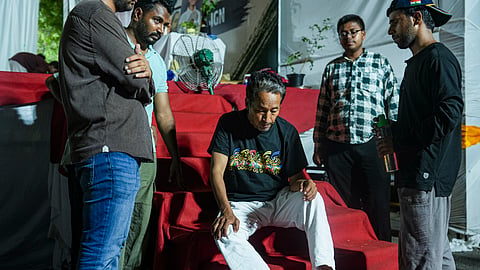

Activist Sonam Wangchuk, who was shifted to Delhi's Safdarjung Hospital after a 20-day hunger strike, has refused intravenous fluids, oral rehydration solution and other medication despite signs of dehydration and metabolic abnormalities, hospital authorities said on Saturday.
Wangchuk is being continuously monitored and counselled to accept treatment in the interest of his health, they said.
The 59-year-old activist was brought to the hospital by Delhi Police and admitted at 7.40 am after his health deteriorated on the 21st day of his indefinite fast at Jantar Mantar. Police said he was shifted on doctors' advice and in compliance with directions of the Delhi High Court. They also said the protest site was being cleared after permission to hold the demonstration expired.
According to a hospital health bulletin, Wangchuk had been fasting from solid food for 20 days and was admitted with generalised weakness. There was no history of fainting.
At the time of admission, he was conscious with stable pulse, blood pressure and oxygen saturation, but showed signs of dehydration.
Blood gas analysis revealed compensated acidosis, decreased serum potassium and a blood sugar level of 78 mg/dl. A repeat serum potassium test showed similar results, while urinary ketones increased from 1+ at admission to 3+ by 1 pm.
"Although intravenous fluids were advised, the patient has refused all intravenous fluids, oral rehydration fluid or any other medication. He is being continuously monitored and counselled for treatment in the best interest of his health," the hospital said.
Sources said doctors were also counselling Wangchuk's family to allow treatment to begin without further delay.
Shortly after his admission, Wangchuk's wife, Gitanjali J Angmo, asked the hospital not to administer any oral or intravenous medicines or fluids without her consent and sought his discharge, alleging a lack of transparency in his medical care.
In two letters to the Medical Superintendent of Safdarjung Hospital, she directed that no treatment be given without her approval and sought copies of all medical reports. In a separate communication, she requested that Wangchuk be discharged so he could be shifted to a hospital of the family's choice, citing a loss of confidence in the facility.
Angmo questioned the decision to hospitalise Wangchuk, saying the Delhi High Court had directed that he receive specialist medical supervision but had not ordered that he be shifted to a hospital. She also claimed the family had not been consulted before he was moved.
She alleged that doctors informed the family Wangchuk's potassium level had dropped from 4.3 to 2.9, describing it as life-threatening, but refused to provide copies of the medical reports despite repeated requests. Claiming Wangchuk was "absolutely fine", she said the family would have him examined independently before consenting to any treatment.
Following Wangchuk's removal from the protest site, Cockroach Janta Party (CJP) founder Abhijeet Dipke alleged that Delhi Police had "forcefully taken away" the activist without initially informing supporters where he was being shifted. Dipke later announced an indefinite hunger strike and said the party's 'Chalo Sansad' march on July 20 would proceed as planned.
Wangchuk began his indefinite hunger strike on June 28 in support of the CJP-led protest over alleged irregularities in the NEET and other examinations and reported student deaths linked to them.
His health had steadily deteriorated over the past three weeks. On Friday, doctors said he had lost nearly 9.5 kg since the beginning of the hunger strike, while his blood pressure and blood sugar levels remained under close monitoring.
Before being shifted to hospital, Wangchuk had said he was determined to continue the fast despite his worsening condition, claiming he had "lost 20 per cent of my body" during the hunger strike.
(With inputs from PTI)
