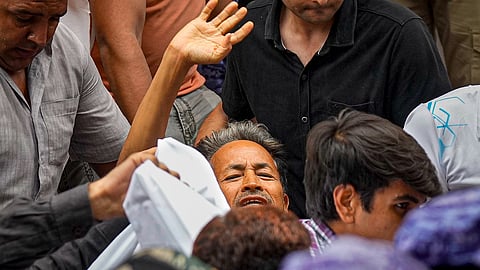

The Delhi High Court on Sunday declined to pass an interim order allowing activist Sonam Wangchuk to be shifted from Safdarjung Hospital to a private medical facility, observing that such a direction was not warranted at this stage. The court, however, directed the authorities to file a fresh status report on his health within three days and listed the matter for hearing on July 24.
Justice Mini Pushkarna said the court had to consider the "larger picture" while hearing a plea filed by Wangchuk's wife, Gitanjali J Angmo, who sought permission to move him to a private hospital of the family's choice.
"Every life is precious," the court observed, noting that Wangchuk was not in detention and that his wife, brother and brother-in-law had been granted access to him. The court also recorded that his family had been provided a separate room and was able to spend time with him.
"Considering this, no interim order is required to be passed at this stage," the judge said.
Wangchuk was taken to Safdarjung Hospital by Delhi Police on Saturday, the 21st day of his indefinite hunger strike. He has been fasting since June 28 in support of the Cockroach Janta Party (CJP)-led protest demanding the resignation of Union Education Minister Dharmendra Pradhan over alleged irregularities in the NEET medical entrance examination and other issues.
In her petition, Angmo said she had "lost faith" in the treatment being provided at the government hospital and wanted her husband shifted before his condition worsened.
Appearing for her, senior advocate Kapil Sibal argued that Wangchuk's own doctors and lawyers had been denied access and were unaware of the treatment or medication being administered.
"The hospital is not giving access to his own doctors, lawyers; and they do not know what he is being prescribed," Sibal submitted.
The plea alleged that despite repeated requests, hospital authorities had refused to discharge Wangchuk or allow his transfer to another hospital.
Angmo also claimed that the heavy police deployment at the hospital effectively restricted the family's movement.
"With around 30 police personnel stationed on our floor and well over 100 across the hospital, our movement is severely restricted. It is not medical care. It is illegal detention," the petition stated, adding that no family should have to fight the system to decide where a loved one receives treatment.
The petition sought a declaration that Wangchuk's continued hospitalisation was unconstitutional and requested his immediate discharge and transfer to a hospital of his and his family's choice. It also sought unrestricted access for his lawyers and doctors who had been monitoring his health during the hunger strike, and directions restraining authorities from administering any treatment without his informed consent or, if he is unable to provide it, without the consent of his wife.
The high court, however, held that the government's decision to hospitalise Wangchuk could not be termed arbitrary.
"Considering the overall perspectives, this court is of the view that since the government has taken the decision to shift Mr Wangchuk to hospital on account of medical condition, this court does not find the same to be an arbitrary action," the order said.
The court noted that doctors at Safdarjung Hospital were closely monitoring Wangchuk's health and had provided oral supplements with his consent.
"It cannot be said that any force is being used against Wangchuk," the court observed.
The judge also remarked that since Wangchuk had not voluntarily admitted himself to a hospital despite his prolonged fast, the government was within its rights to intervene on medical grounds.
During the hearing, Additional Solicitor General Chetan Sharma, appearing for the Centre, said Wangchuk's health had deteriorated after more than 18 days of fasting.
He argued that prolonged fasting could lead to ketosis and dangerous electrolyte imbalances such as hypokalemia, which could trigger shock even if vital parameters initially appeared stable.
Sharma also submitted that the authorities acted in accordance with an earlier order of the high court directing officials to monitor Wangchuk's health and intervene medically if necessary.
"He should, like any other individual in this country, have complete faith in doctors," Sharma said, adding that Wangchuk could also be shifted to AIIMS if required.
"The President of India also receives treatment there," he remarked.
The ASG maintained that Wangchuk's wife had unrestricted access to him and urged the activist to cooperate with the treating doctors.
A doctor from Safdarjung Hospital informed the court that Wangchuk had begun taking oral fluids, potassium supplements and sugar-free oral rehydration solution but had declined intravenous fluids despite repeated requests.
Responding to the government's arguments, Sibal questioned whether a citizen could be prevented from choosing a hospital of their preference.
"He is not in detention; there is no case against him. Is a citizen of India not entitled to say, 'I want to go to the hospital of my choice'?" Sibal argued.
He also contended that the July 16 order directing authorities to monitor Wangchuk's health had been passed ex parte, without Wangchuk or his representatives being heard.
"I want treatment, but I want treatment of my choice," Sibal submitted on behalf of his client.
Angmo's petition accused hospital authorities of sharing only selective information regarding Wangchuk's medical condition and preventing any independent assessment of his health.
She alleged that the police had taken "colourable advantage" of the July 16 court order to forcibly remove Wangchuk from the Jantar Mantar protest site despite there being no medical emergency.
"There existed no medical emergency or other circumstance warranting such abrupt and coercive intervention," the petition said, adding that the forcible removal violated Wangchuk's fundamental rights.
The plea also questioned the accuracy of the hospital's medical reports, alleging discrepancies in Wangchuk's potassium levels.
According to the petition, blood samples provided by the hospital after a delay of over 10 hours showed a potassium level of 3.6 when tested independently, compared with the 2.9 level earlier disclosed by hospital authorities.
"The mala fide conduct of the respondents is thus evident from the results," the petition alleged.
In a post on X after the hearing, Angmo said no family should have to fight for the right to choose where a loved one receives medical treatment. She also alleged that Safdarjung Hospital's public health bulletin had "conveniently omitted" Wangchuk's actual potassium level.
(With inputs from PTI)
