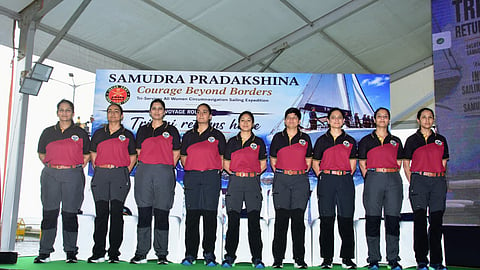

NEW DELHI: Nine women officers drawn from the Army, Navy and Indian Air Force (IAF) sailed into Mumbai on Wednesday after completing the world’s first circumnavigation by an all-women tri-services crew, capping a 314-day, 25,500-nautical-mile voyage across four oceans and around the three Great Capes.
Defence minister Rajnath Singh, who flagged off the Samudra Pradakshina expedition in September last year, addressed the flag-in ceremony via video link. The crew was also received by Southern Army Commander Lt Gen Rajesh Pushkar, who took charge of the Pune-based command earlier this month.
Drawn from all three Services, the historic nine-member sailing crew was led by Lt Col Anuja Varudkar of the Army, with Sqn Ldr Shradha P. Raju of the IAF as her deputy and includes four officers each from the Army and IAF and one from the Navy.
The others are Wg Cdr Vibha Singh, Sqn Ldr Vaishali Bhandari and Sqn Ldr Aruvi Jayadev of the IAF, Lt Cdr Priyanka Gusain of the Navy and Maj Karamjeet Kaur, Maj Omita Dalvi and Maj Prajakta Nikam of the Army.
Their boat, the 50-foot IASV Triveni built at Puducherry, ticked off every internationally recognised test for a circumnavigation. It crossed the Equator twice, sailed across every meridian of longitude and rounded all three Great Capes, Cape Leeuwin, Cape Horn and the Cape of Good Hope. Before setting out, the yacht had already logged more than 10,000 nautical miles in training.
Officials told TNIE that the crew's toughest leg came in the Southern Ocean where sailing through the Roaring Forties and Furious Fifties, the crew battled 8 to 12-metre swells, gale-force westerlies and sub-zero wind chill, with the nearest land often thousands of miles away.
In late December, the team crossed the International Date Line deep in the Southern Ocean, marking the longitudinal halfway point of the circumnavigation. Seven weeks later came the expedition’s toughest test. After negotiating the Drake Passage, among the world’s most violent stretches of water, the crew rounded Cape Horn, joining the small fraternity of “Cape Horners”, a distinction claimed by only a handful of Indian sailors.
The sailing vessel also made four overseas port calls during the voyage, including Fremantle in Australia and Cape Town in South Africa. After clearing the last of the three Great Capes, the crew crossed the Equator northbound again last month and began the final leg home across the Indian Ocean.
The circumnavigation required nearly two years of preparation, including a 4,000-nautical-mile qualifying voyage to Seychelles and back in April-May last year, after which the final nine-member crew was selected from dozens of volunteers.
The feat also adds to a line of Indian blue-water sailing that began with Commander Dilip Donde's first solo circumnavigation aboard INSV Mhadei in 2009-10.
Commander Abhilash Tomy followed in 2013 as the first Indian to sail solo non-stop and unassisted around the world, a feat that earned him the Kirti Chakra. Five years later, in the 2018 Golden Globe Race, he was dismasted and gravely injured when a storm rolled his yacht deep in the southern Indian Ocean. After a three-day long global search and rescue ops, the officer was finally rescued.
The Navy sent its first all-women crew around the globe under Navika Sagar Parikrama, completed in 2018 by six officers aboard INSV Tarini. Its sequel saw Lt Cdr Dilna K and Lt Cdr Roopa A sail the same vessel around the world in two-handed mode, the first women to do so. The pair subsequently also became the first women to be awarded the Shaurya Chakra earlier this year.
