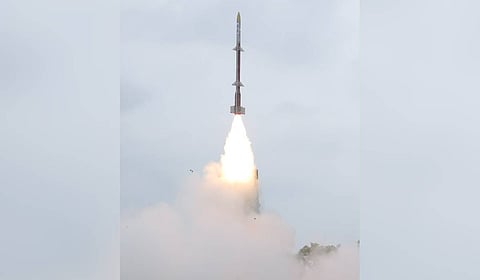

NEW DELHI: The Defence Research and Development Organisation (DRDO) on Thursday successfully conducted the maiden flight-test of the ‘Kusha’ long-range surface-to-air missile from the APJ Abdul Kalam Island off the Odisha coast, taking India’s most ambitious homegrown air defence programme into its flight trial phase.
The test was conducted against an electronic target simulating a high-speed, high-altitude aerial threat, which was successfully intercepted by the missile system, the defence ministry said.
Crucially, the trial validated the system as a whole rather than the missile alone. All weapon system elements, including the missiles, radars and the command and control centre, have been developed by DRDO laboratories and Indian industry partners, the ministry added.
The long-range air defence system is geared to neutralise fighter jets, missiles, unmanned aerial vehicles and large enemy aircraft across a wide range and altitude envelope.
Formally designated the Extended Range Air Defence System and earlier known as XRSAM, Kusha was cleared for development by the Cabinet Committee on Security in 2022 with an outlay of about Rs 21,700 crore. The MoD subsequently granted an acceptance of necessity (AoN) in September 2023 for multiple squadrons for the IAF, which is the lead service, with the Navy expected to follow with a shipborne requirement.
The Defence Research and Development Laboratory leads interceptor development, Research Centre Imarat is developing the seekers, and Bharat Electronics is the principal production partner, with Bharat Dynamics involved in missile manufacture.
Ground validation, including trials of the dual-pulse rocket motor that gives the interceptor its terminal energy, was completed before Thursday’s launch.
Kusha is built around three interceptors of progressively longer reach, the M1 at around 150 km, the M2 at around 250 km and the M3 at up to 400 km. The tiered design allows a single battery to engage threats at varying distances instead of expending a long-range missile on every target.
The fresh test, however, covers only the opening stretch. Flight evaluation of the first interceptor has to be completed and repeated, after which the M2 and M3 will be trialled in sequence, each requiring validation of longer-burn propulsion, seeker performance at extended range and radar tracking at greater distances.
Developmental trials must then give way to user trials by the IAF, a phase that typically runs one to three years and tests the system under service conditions rather than instrumented range conditions. Early elements are expected to be operational around 2028, with phased induction of all three variants planned through 2030.
Why India needs it
The IAF currently fields the 80-km MR-SAM at one end of its long-range spectrum and the imported S-400 Triumf at the other, leaving the intermediate band thinly held by a system India does not build.
The value of that outer band was demonstrated during Operation Sindoor last year, when an IAF S-400 battery shot down a Pakistan Air Force Saab 2000 Erieye airborne early warning and control aircraft at 314 km, the longest recorded surface-to-air missile kill. Air Chief Marshal AP Singh later confirmed the engagement, and the IAF has since displayed recovered canister debris linked to the 40N6E interceptor fired in the strike.
However, only four of the five contracted S-400 squadrons have been delivered since 2018, the fourth arriving only in June this year after delays caused by the war in Ukraine, with the last expected by the end of 2026. Sustainment, spares and replenishment remain dependent on a single foreign supplier.
Kusha is intended to deliver that class of capability with the supply chain held at home, allowing squadrons to be raised on India’s schedule rather than a partner’s delivery calendar.
The programme also sits inside Mission Sudarshan Chakra, announced by Prime Minister Narendra Modi on Independence Day last year as a decade-long effort to build an AI-enabled, multi-layered air and missile defence shield over strategic installations and civilian sites by 2035.
Under the DRDO-led mission, the shield is to be built in tiers, beginning with space-based detection, coming down through mid-tier interception and ending in point defence handled by anti-drone systems and directed-energy weapons. It is not purely defensive as the plan folds in offensive reach as well, with the 500-km Pralay quasi-ballistic missile and BrahMos variants of extended range.
Kusha occupies the long-range interception tier in this scheme. Below it sits the Akash-NG for medium ranges, above it the two-tier ballistic missile defence network, with all of them meant to plug into the IAF’s Integrated Air Command and Control System (IACCS) that fuses radar, AWACS and fighter data into a single air picture.
