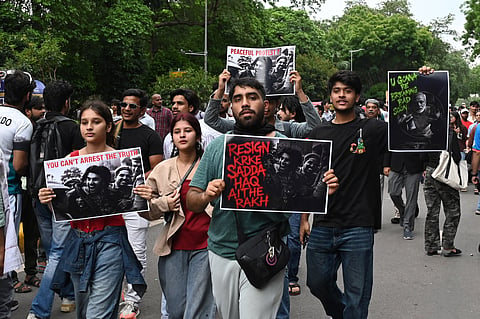

The Supreme Court on Friday said it will closely monitor the Centre's efforts to prevent future NEET paper leaks, stressing that temporary fixes cannot substitute long-term institutional reforms in the examination system.
Hearing a batch of petitions, including one filed by the Federation of All India Medical Association (FAIMA), a bench of Justices P S Narasimha and Alok Aradhe asked the Centre to place on record the measures taken to improve transparency, implement the Radhakrishnan Committee's recommendations, and adopt the IIT model for conducting examinations.
Appearing for the Centre, Solicitor General Tushar Mehta informed the court that the government would file a detailed report outlining reforms, including measures beyond those suggested by the Radhakrishnan Committee.
"Students' futures can't be jeopardised. We are going beyond the Radhakrishnan Committee. I assure you that the government is walking 10 extra miles. I can assure you everything is being supervised at the highest level," Mehta submitted.
Mehta also told the bench that when a similar issue arose two years ago, the government had explained the safeguards in place, covering everything from the printing of question papers to their transportation.
The bench, however, observed that while the government had even deployed the Air Force to transport question papers for the NEET-UG retest, such arrangements were temporary in nature.
"Ad hocism has troubled us for years," Justice Narasimha said, while pointing out that the court will ensure that institutionalisation of the examination process takes place.
During the hearing, advocate Tanvi Dubey, appearing for FAIMA, sought a detailed standard operating procedure (SOP) for the computer-based test (CBT) model that the National Testing Agency plans to introduce for NEET-UG from next year.
(With inputs from PTI)
