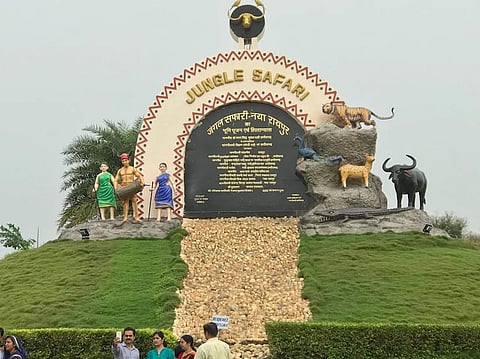

RAIPUR: Spanning across a vast expanse of 320 hectares, the Nandanvan Jungle Safari in Naya Raipur (Atal Nagar) in Chhattisgarh has established itself as a premier destination for nature lovers, wildlife enthusiasts, and tourists.
The state-of-the-art wildlife centre offers visitors a captivating opportunity to witness animals in their near-natural habitats while actively promoting environmental awareness and species conservation.
The origin of Nandanvan traces back to 1979, when it was initially established in Raipur as a rescue and rehabilitation centre known as the "Nandanvan Mini Zoo." It received official recognition from the Central Zoo Authority (CZA) in 2008.
To expand its footprint and modernise wildlife tourism, 320.15 hectares of land were allocated between 2012 and 2015 in Naya Raipur.
Nandanvan Jungle Safari was later inaugurated by Prime Minister Narendra Modi on November 1, 2016.
Designed with apt safety standards and visitor comfort in mind, the park is divided into five dedicated zones.
Herbivore Safari (31 hectares): Free-roaming spotted deer (Chital), Sambar, Nilgai, and Blackbucks.
Bear Safari (20 hectares): Tourists observe sloth bears navigating natural terrain.
Tiger Safari (20 hectares): Exhilarating up-close view of India's national animal, the Royal Bengal Tiger.
Lion Safari (20 hectares): Conservation and protection of Asiatic Lions.
Zoo Zone (50 hectares): Extensive collection of bird species, reptiles, small mammals.
The safari park has in recent years witnessed remarkable growth and tourist footfall”, said Thejas Shekhar, Divisional Forest Officer.
Beyond standard safari rides, Nandanvan actively participates in national animal exchange programmes. Major highlights for visitors include rare wildlife such as white tigers, hippopotamuses, gharials, and the celebrated cloned wild buffalo named 'Deepasha.'
The primary objectives of the facility remain focused on rare species breeding, wildlife rescue, and ecological education.
